
My Neighbor Demanded I Cut Down My Apple Tree …Then One Morning, My Entire Yard Was Covered in Apples
My husband planted our apple tree twelve years ago, just a few months before he passed away.
Dean had been ill for a while by then, though neither of us liked to admit how serious it had become. Even carrying a bag of soil left him breathless, but he was determined to plant the young sapling himself.
“This is the best place,” he said, pointing toward a sunny corner of the garden.
I reminded him that his doctor had forbidden heavy lifting.
“It’s a tree, Sloane,” he replied with a grin. “Not a weightlifting competition.”
We planted it together.
Truthfully, I did most of the digging while Dean sat nearby, giving instructions. When we finished, he rested one hand against the thin trunk.
“Give it time,” he said. “It’ll surprise you.”
Dean died four months later.
For the next two years, the tree produced nothing. I nearly had it removed because looking at it hurt too much. Every time I saw that bare trunk, I thought of him.
Then, one spring, it finally bloomed.
That autumn, it produced twelve apples.
I counted every one.
As the years passed, the tree grew stronger. Eventually, it produced enough fruit for pies, cider and applesauce, with plenty left over for neighbours and children who came knocking to ask if they could pick one.
I always said yes.
The tree became part of the neighbourhood.
But to me, it remained one of the last living things Dean had touched.
Then Ryan moved into the house next door.
Within weeks, he replaced his mailbox, tore out every flower from his front garden and covered the ground with white stones.
One afternoon, he knocked on my door and immediately pointed toward my backyard.
“We need to discuss your tree.”
“The apple tree?” I asked. “It’s beautiful.”
“It’s messy,” he replied. “Its branches cross the fence, and fruit falls into my garden.”
I offered to trim the branches and collect anything that fell onto his property.
Ryan shook his head.
“I don’t want it trimmed. I want it removed.”
“That is not happening.”
He launched into a lecture about property values, insects and appearances. I reminded him that the tree stood entirely on my land.
His expression hardened.
“You may not like what happens next.”
The following day, I hired someone to cut back every branch that crossed the fence. Nothing from the tree would fall into Ryan’s garden again.
That should have settled the matter.
It didn’t.
Ryan kept complaining.
He claimed the roots would damage his foundation. He said the apples attracted rodents. Eventually, he filed a formal complaint with the homeowners’ association.
Mira, the association representative, inspected the tree and found no violation.
“The tree is on Sloane’s property,” she told Ryan. “You are not allowed to damage it.”
After that, Ryan stopped speaking to me.
But he kept watching.
Whenever I worked outside, I could feel his eyes following me from his kitchen window.
That was why I quietly set up a trail camera behind a hedge, facing the tree and the garden gate.
I hoped I would never need it.
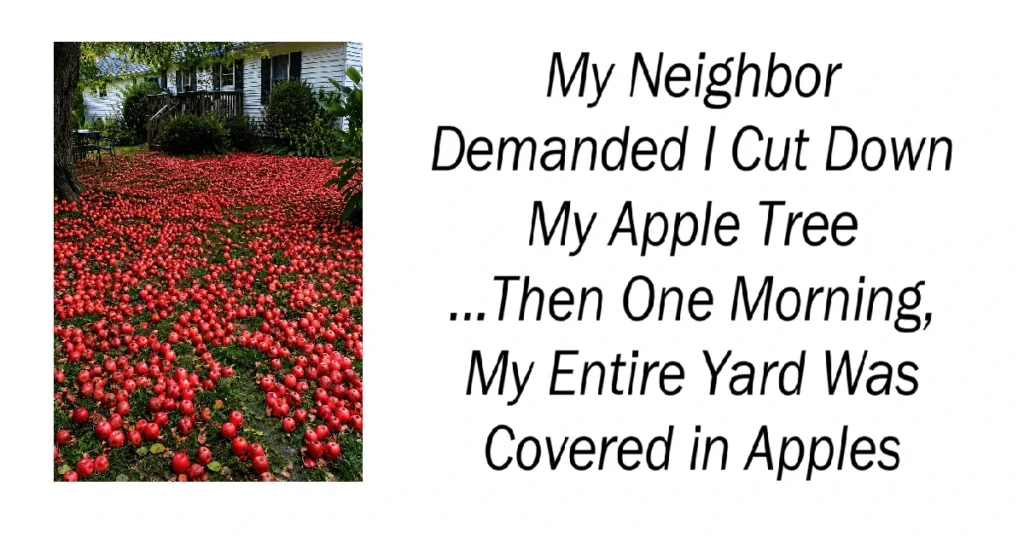
Three weeks later, I woke to find hundreds of apples scattered across my lawn.
Nearly every fruit had been torn from the tree. Several smaller branches were broken, and the soil beneath them had been disturbed.
I wasn’t crying over apples.
Someone had come onto my property and deliberately damaged the tree Dean had planted.
Ryan appeared on his porch, holding a cup of coffee.
“Did you do this?” I asked.
He looked at the ruined fruit and smiled.
“Must have been a strong wind.”
There had been no wind.
He was waiting for me to shout, cry or lose control.
Instead, I smiled back.
“It must have been.”
Then I went inside and opened the trail-camera footage.
PART 2 — THE STRONG WIND
The recording showed everything.
At 12:47 a.m., Ryan climbed over my fence carrying a fruit picker and two buckets.
He stripped apples from the branches, shook the smaller limbs and climbed into the tree when some fruit wouldn’t come loose.
Several branches snapped beneath his weight.
Then he carried the apples to my front garden and dumped them across the grass.
He made six trips.
On the final one, he stopped directly in front of the hidden camera to catch his breath.
His face was perfectly visible.
I watched the footage twice.
Then I started planning.
I gathered every apple that remained whole and left the damaged branches untouched. At two in the morning, I carried paper tags, string, gloves, a wheelbarrow and a large sign into my garden.
For the next three hours, I attached a numbered tag to every usable apple.
Each tag read:
“Removed from Sloane’s tree without permission.”
There were 245 apples.
I carefully carried them to Ryan’s garden and arranged them in perfect rows.
I didn’t throw them. I didn’t damage his plants. I didn’t touch his house.
In the centre of the display, I placed a sign:
“Strong wind appears to blow both ways.”
Then I went inside and made coffee.
Ryan discovered the apples at sunrise.
His shouting woke half the street.
“What is this?” he yelled.
I stepped onto my porch.
“The wind must have been especially strong last night.”
“You did this!”
“I have no idea what you mean.”
“I’m reporting you to the homeowners’ association.”
“Go ahead.”
He had walked straight into the trap.
Mira arrived twenty minutes later. Ryan rushed toward her, claiming that I had covered his property with rubbish.
She examined the neatly arranged rows and read the sign.
“Sloane, did you place these here?”
“Yes,” I answered. “I also have video showing how they were removed from my tree and scattered across my garden.”
The colour drained from Ryan’s face.
Mira turned toward him.
“Did you enter her property?”
“No.”
I held up my phone and played the recording.
The video showed Ryan climbing the fence, filling the buckets, breaking branches and dumping the fruit.
When it ended, the street fell silent.
Ryan claimed the branches had crossed onto his property.
The footage clearly showed him entering mine.
Then he accused me of editing the video.
Mira’s expression hardened.
“You had no right to enter her garden, damage her tree or remove the fruit.”
Ryan pointed toward the apples on his lawn.
“And she had the right to do this?”
“Placing items on another person’s property is not advisable,” Mira replied.
“I’ll remove them,” I said.
“After they’ve been documented,” she added.
By then, several neighbours had gathered nearby.
Mrs. Patel from across the road stared at Ryan.
“You climbed into her garden in the middle of the night?”
Ryan ignored her.
Mira took out her phone.
“What are you doing?” he demanded.
“Calling the police.”
His confidence vanished.
“That isn’t necessary.”
“You trespassed and damaged private property.”
“It was only a tree.”
“It was not your tree.”
When the officers arrived, Ryan changed his story several times.
First, he said the apples had fallen naturally.
Then he claimed he had entered my garden to clean them up.
Finally, he insisted I had given him permission.
The video disproved every version.
An arborist inspected the tree later that day. Two branches had suffered serious damage, but the tree would survive.
Ryan was fined, ordered to pay the repair costs and assigned community service.
The judge seemed to have a sense of humour.
Ryan was sent to help maintain the public orchard in the town park.
For several Saturdays, he picked apples, cleared leaves and removed fallen fruit from the paths.
The first time I drove past and saw him carrying a basket, I laughed so hard I had to pull over.
PART 3 — THE TREE SURPRISED ME
After the incident, the neighbourhood changed.
People started checking on me more often. Mira even asked whether I would consider organising a community apple day the following autumn.
At first, I wanted to say no.
Although I had always shared the fruit, the tree still felt deeply personal. It belonged to the memories Dean and I had created together.
Then I remembered him standing beside that fragile sapling.
“Give it time,” he had said. “It’ll surprise you.”
So I agreed.
The following spring, the tree bloomed again.
Not every damaged branch recovered, but the healthy limbs filled with white flowers. By September, apples hung from them once more.
Mira brought folding tables into my garden. Families arrived carrying jars, pie dishes, cutting boards and cider presses.
Children picked apples under supervision. Mrs. Patel taught several teenagers how to make apple butter. Someone burned the first pie, while someone else put far too much cinnamon in the cider.
The entire street smelled sweet.
For the first time, Dean’s tree no longer felt like something I had to protect alone.
It had become part of something larger.
Ryan stayed inside for most of the afternoon.
I didn’t invite him, but I didn’t ask anyone to shut him out either.
Near the end of the celebration, two children carried a paper plate to his front door. A slice of apple pie sat on it beside a cup of cider.
Ryan opened the door and looked at the children.
Then he looked across the street at me.
For a moment, neither of us moved.
Finally, he accepted the plate.
“Thank you,” he said.
It wasn’t an apology.
We didn’t become friends.
But Ryan never complained about the tree again. He kept his distance, respected the fence and left my property alone.
That was enough.
Dean’s tree still reminds me of his patience, his humour and his belief that good things can keep growing after terrible loss.
But now it reminds me of something else, too.
When Ryan stripped the tree bare, I thought he had damaged one of my last connections to my husband.
Instead, he forced me to defend it.
He taught me that staying polite doesn’t mean allowing someone to walk all over you.
And somehow, the tree that once represented only grief became the centre of an entire community.
Dean had been right from the beginning.
All I needed to do was give it time.
The tree surprised me.
You’ve just read . Why not read Vertical Lines on Your Nails