
What the “Odd One Out” Animal Puzzle May Reveal About Your Thinking Style
If you’ve spent any time online lately, you’ve probably seen those quick visual puzzles asking you to spot the “odd one out.”
At first glance, they seem like harmless little games — something fun to pass a few spare minutes. But psychologists have long suggested that the way we notice patterns, categorize objects, and explain our choices can reveal interesting clues about how our minds naturally process information.
Today’s puzzle is a perfect example.
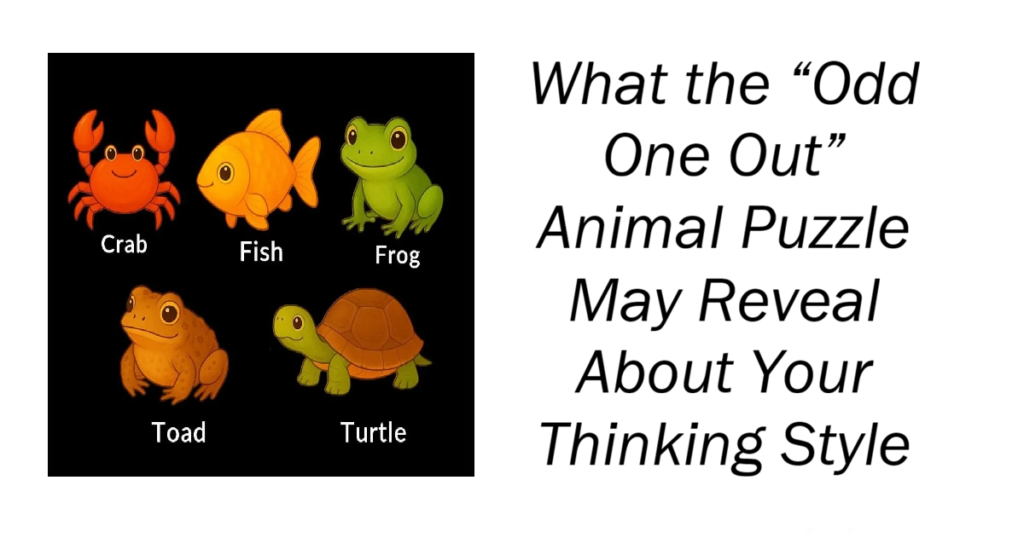
Imagine five cheerful cartoon animals lined up in front of you:
- A crab
- A fish
- A frog
- A toad
- A turtle
Your task is simple:
Choose the one that feels different from the others.
Sounds easy — but here’s the interesting part:
There is no single correct answer.
Each animal can logically be considered the “odd one out” depending on what your brain notices first. And that’s exactly what makes this puzzle so fascinating.
Before reading further, pause for a moment and picture the animals in your mind. Don’t overthink it. Just notice which one naturally stands out to you.
Now let’s explore what your choice might say about the way you think.
If You Chose the Crab
People who pick the crab often notice shape and structure first.
Compared to the other animals, the crab looks physically different:
- Rounded body
- Sideways movement
- Claws
- Multiple legs
While the fish, frog, toad, and turtle share a more familiar body shape, the crab immediately breaks the visual pattern.
If this was your choice, you likely:
- Think logically
- Notice patterns quickly
- Prefer clarity and structure
- Focus on concrete details
You probably approach problems in a direct, organized way and feel comfortable making decisions based on clear evidence rather than emotion.
Others may see you as practical, reliable, and good at simplifying complicated situations.
If You Picked the Fish
The fish is unique because it is the only animal that lives entirely underwater.
The others may spend time in or around water, but they also live on land in some capacity.
If you noticed the fish first, your mind may naturally focus on:
- Environment
- Context
- Relationships
- The bigger picture
Rather than concentrating only on appearance, you likely think about how things connect to their surroundings.
This often suggests:
- Strong intuition
- Creative thinking
- Thoughtful decision-making
- Awareness of subtle connections
You may naturally see possibilities and perspectives that others overlook.
If the Frog Stood Out to You
Frogs are famous for transformation.
They begin life as tadpoles before undergoing one of nature’s most remarkable changes into adult frogs.
If you chose the frog, you may naturally think in terms of:
- Growth
- Change
- Development
- Personal evolution
You likely recognize that people and situations evolve over time.
This can suggest a personality that is:
- Reflective
- Emotionally aware
- Compassionate
- Open-minded
You may be especially sensitive to life’s transitions and the emotional journeys people experience.
Others probably see you as understanding and supportive.
If You Chose the Toad
At first glance, frogs and toads seem almost identical.
But people who choose the toad often notice the subtle differences:
- Drier skin
- Different movement
- More land-based habits
- Distinct texture and appearance
If this was your answer, you likely have a sharp eye for nuance and detail.
You may naturally:
- Notice small inconsistencies
- Pay attention to subtle differences
- Analyze carefully before deciding
- Think deeply before forming conclusions
This type of thinking often makes people dependable, observant, and thorough.
You probably notice things others miss.
If You Picked the Turtle
The turtle is biologically unique because it is the only reptile in the group.
It also carries its shell — its protective “home” — wherever it goes.
If the turtle stood out to you, you likely organize information through:
- Categories
- Facts
- Systems
- Scientific reasoning
You may enjoy understanding how things fit together logically.
This often suggests someone who is:
- Methodical
- Curious
- Analytical
- Knowledge-oriented
People who choose the turtle often enjoy learning, researching, and understanding deeper structures beneath the surface.
What This Puzzle Really Shows
This puzzle isn’t meant to scientifically define your personality.
Instead, it highlights something much more interesting:
People can look at the exact same image and see completely different things — all for valid reasons.
Some minds focus on:
- Appearance
- Biology
- Environment
- Transformation
- Fine details
- Classification
None of these approaches are wrong.
They simply reflect different ways of processing information and understanding the world.
Why These Puzzles Fascinate Us
Part of the appeal comes from self-discovery.
Even simple visual riddles can reveal:
- What grabs our attention first
- How we organize information
- Whether we think broadly or specifically
- How our brains naturally solve problems
In a fast-moving world full of distractions, these tiny moments of reflection can actually feel refreshing.
They remind us that every mind works a little differently — and that individuality is something worth appreciating.
Final Thoughts
The real beauty of this puzzle isn’t finding the “correct” answer.
It’s realizing that your instinctive choice reflects the unique way your mind sees patterns, relationships, and meaning.
Whether you focused on shape, habitat, transformation, detail, or biology, your answer says something quietly interesting about how you experience the world.
And sometimes, something as simple as five cartoon animals can remind us that there are many different ways to think — all equally valid, all uniquely human.
You’ve just read . Why not read What It Really Means When You Find a Coin on the Ground
You’ve just read What It Really Means When You Find a Coin on the Ground. Why not read Red Swollen Burning Foot