
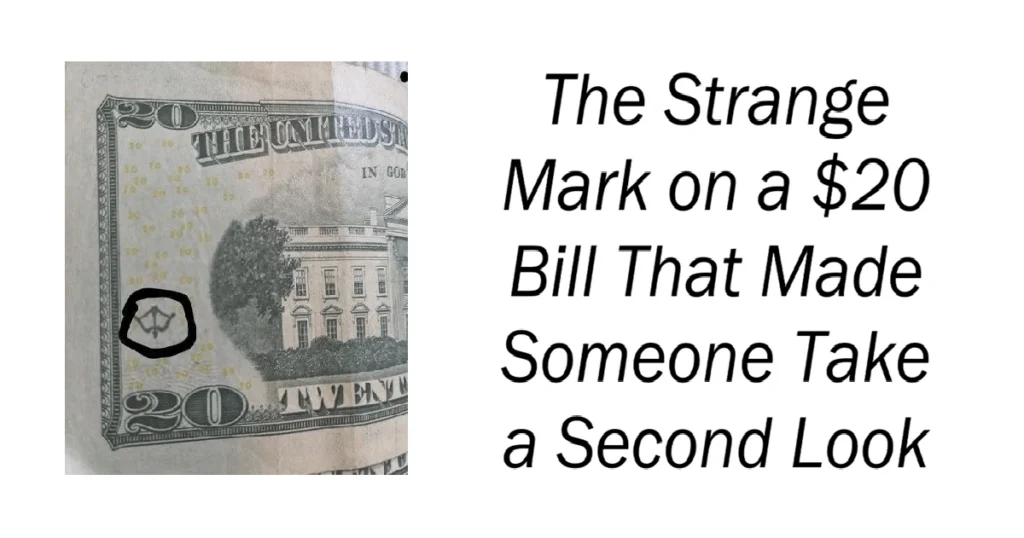
The Strange Mark on a $20 Bill That Made Someone Take a Second Look
Most people wouldn’t give a second thought to a small mark on a $20 bill. We handle cash every day, and a little ink, stamp, or unusual symbol can easily go unnoticed.
But what happens when that mark looks completely out of place?
In this fictional story, one person discovered a $20 bill with a distinctive circled symbol printed in an unexpected area. At first, he assumed someone had simply written or stamped on the note. But the mark was unusually neat, and that was enough to make him wonder whether there was more to the bill than met the eye.
A $20 Bill Worth Keeping?
The discovery happened while he was counting his change after a shopping trip. Rather than putting the bill back into his wallet and eventually spending it, he set it aside for a closer look.
A few days later, he showed it to a local currency collector.
The collector explained that unusual markings on banknotes can have many different explanations. Some are added after a note enters circulation, while others can be connected to handling, identification, testing, or collecting.
And there’s an important distinction to make: a strange-looking mark doesn’t automatically mean a banknote is rare or valuable.
Genuine printing errors can sometimes attract considerable interest from collectors, but a random stamp, pen mark, or other alteration made after production generally doesn’t have the same significance.
An Unusual Collector’s Find
After examining the fictional bill, the collector believed that the particular combination of its unusual mark and other identifying characteristics could make it interesting to a small group of collectors.
Eventually, the owner received a hypothetical offer of $250—more than 12 times the bill’s $20 face value.
That doesn’t mean every $20 bill with an unusual mark is worth hundreds of dollars. In this fictional example, the value came from the specific combination of characteristics and, ultimately, from finding a collector interested in that particular variation.
Don’t Spend It Just Yet
If you ever notice something unusual about a banknote, there’s no harm in taking a closer look before spending it.
Check the serial number, printing alignment, condition, and the nature of the unusual marking. Most importantly, try to determine whether the feature was actually part of the original printing process or was added later.
A strange mark might be nothing more than everyday wear—or it could be something worth researching.
In this fictional case, an ordinary $20 bill became an intriguing collectible simply because its owner noticed that something didn’t quite look right.
You’ve just read The Strange Mark on a $20 Bill. Why not read A Glass of This Juice Everyday Will Remove Clogged Arteries