
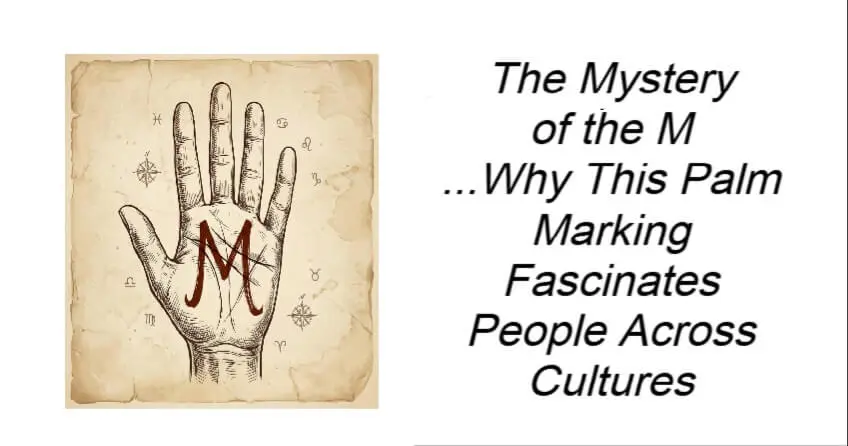
The Mystery of the M …Why This Palm Marking Fascinates People Across Cultures
For as long as humans have studied the lines on their palms and wondered what they might reveal, the mysterious “M” formation has stood out as one of the most talked-about markings. Palmistry has never claimed to be a science, yet it has endured for centuries because it taps into something deeply human: our love of stories, symbols, and personal meaning.
The lines on our hands aren’t temporary. They’re with us for life, quietly inviting interpretation. That sense of permanence makes them feel significant, even if we know the explanations are rooted in tradition rather than evidence.
What Is the “M” on the Palm?
The “M” shape appears when the major palm lines—most commonly the heart line, head line, and life line, sometimes joined by the fate line—intersect in a way that resembles the letter. Not everyone has it, and many people don’t notice it until someone points it out. Once seen, though, it’s hard to ignore.
Curiosity tends to follow immediately.
A Symbol Shaped by Culture, Not Science
Across civilizations, the palm has long been treated as a kind of personal map. Palmistry spread across continents well before modern communication, evolving differently in each culture while retaining its core appeal. Even today, people explore palm-reading much like horoscopes—not as fact, but as reflection, entertainment, and storytelling.
Within this folklore, the “M” has become associated with qualities people admire.
One of the most common interpretations is intuition—not supernatural insight, but a sharp awareness of situations and people. Those drawn to palmistry often describe individuals with the “M” as observant, perceptive, and quietly insightful, noticing details others overlook.
Another recurring theme is clarity. The “M” is said to symbolize someone who understands their direction, values, or boundaries. In traditional storytelling, elders sometimes used the symbol as encouragement: a gentle reminder to trust oneself and move forward with confidence.
Different Meanings for Different Traditions
Interpretations vary widely depending on cultural context. In some traditions, women with the “M” were believed to possess heightened emotional intelligence—an ability to sense dishonesty, shifts in mood, or unspoken intentions. Long before terms like emotional awareness existed, folklore used symbolism to acknowledge those traits.
For men, older readings often emphasized decisiveness and inner strength. The “M” was viewed as the mark of someone willing to take initiative—not aggressively, but with steady conviction.
None of these meanings come from research or measurable proof. They come from generations of stories, passed down and reshaped over time. And that’s precisely why the symbol continues to captivate.
Why the “M” Still Matters
Palmistry isn’t about predicting the future. It’s about introspection. When people hear what a symbol is said to represent, they naturally reflect on themselves—what feels accurate, what doesn’t, and what they hope to grow into.
For many, discovering the “M” is simply a moment of connection. A grandmother might recognize it in a child’s hand and recall a story from her own past. Friends compare palms for fun. Strangers use it as a lighthearted conversation starter that unexpectedly turns thoughtful.
The marking itself matters less than the dialogue it creates.
What makes the “M” especially compelling is its universality. Different cultures developed their own interpretations, yet the fascination endured. That persistence says something meaningful about human nature: we instinctively look for patterns and stories that help us understand who we are.
A Symbol, Not a Destiny
The truth is simple. The “M” doesn’t predict success, wisdom, or fate. But the traits traditionally associated with it—intuition, awareness, honesty, determination, clarity—are qualities people value. The symbol lasts because it reflects what we admire, not because it promises anything.
There’s also something comforting in knowing the “M” forms from the same lines everyone has. What changes is how those lines intersect, how each hand develops, and how each person chooses to interpret what they see. For some, it’s coincidence. For others, it’s affirmation. For many, it’s just a charming curiosity.
The Real Meaning Behind the Mark
Palmistry lives in the space between tradition and imagination. People don’t turn to their hands for scientific answers—they turn to them for meaning, reflection, and a sense of wonder. The “M” sits right at the center of that space: a symbol shaped by chance, defined by culture, and sustained by curiosity.
Whether someone believes in palm-reading or not, its appeal is undeniable. The lines on your hand are uniquely yours, shaped by genetics, movement, and time. The “M” is just one of many patterns people have interpreted across history, but it remains one of the most captivating.
Perhaps that’s its true power. Not the folklore itself, but the pause it creates—the moment someone stops, looks closer, and reflects on their own identity, strengths, and values.
In a world that rarely slows down, even a brief moment of reflection can feel meaningful. And sometimes, all it takes is a simple marking in the palm of your hand.
You’ve just read, The Mystery of the M. Why not read Manager Had To Hire A New Employee.