
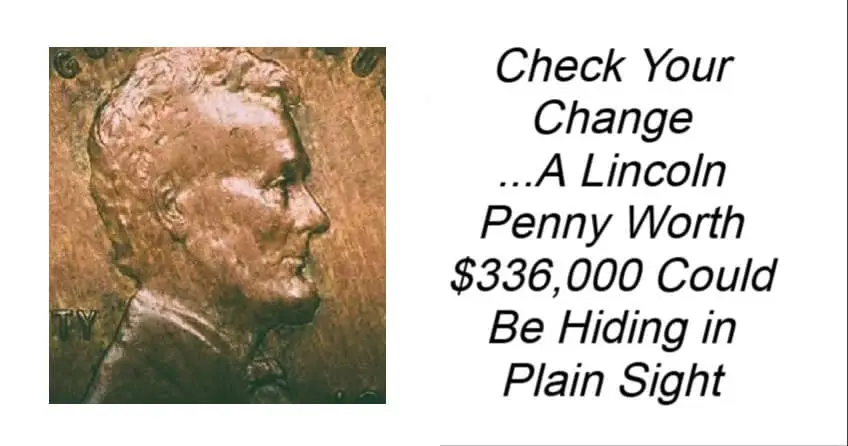
Check Your Change …A Lincoln Penny Worth $336,000 Could Be Hiding in Plain Sight
Most coins pass through our hands without a second thought. Spare change rattles in cup holders, pennies get dropped on sidewalks, and jars of loose coins sit untouched for years. But every so often, a completely ordinary-looking coin turns out to be anything but ordinary.
Somewhere among America’s billions of pennies exists a rare mistake so valuable that a single example has sold for hundreds of thousands of dollars—and in exceptional cases, more than a million. It’s known as the 1943 Bronze Lincoln Cent, and its story is rooted in wartime urgency, human oversight, and sheer chance.
A Wartime Coin That Wasn’t Supposed to Exist
To understand why this penny is so valuable, you have to go back to 1943. The United States was deep in World War II, and copper was a critical resource. It was needed for ammunition, electrical wiring, and military equipment—far more important than everyday pocket change.
So the U.S. Mint made a historic decision: pennies would no longer be made of bronze. Instead, they would be struck from zinc-coated steel, conserving copper for the war effort. It was the first time since the late 1700s that the cent’s composition had changed so drastically.
The result was the now-famous steel penny—lighter, silver-gray in color, and prone to rust. People found them confusing and inconvenient, but the country accepted them as a necessary wartime compromise.
The Accidental Penny
During the transition from bronze to steel in late 1942, something unexpected happened. A small number of bronze planchets—the blank discs used to strike pennies—were accidentally left behind in the minting presses.
When production of 1943 pennies began, those leftover bronze blanks were struck with 1943 dies, creating pennies that technically should never have existed. No special order. No intentional release. Just a handful of coins born from a manufacturing oversight during one of the most pressured production periods in U.S. Mint history.
A Discovery That Sparked a National Treasure Hunt
The first 1943 bronze pennies didn’t surface until 1947. When they did, collectors were stunned. Wartime minting was tightly controlled, and errors of this magnitude were exceptionally rare.
News spread quickly. Newspapers reported on the discovery, collectors combed through old coin jars, and ordinary Americans checked their pockets with renewed hope. Kids emptied piggy banks searching for a copper-colored penny instead of steel. For a while, the nation was on a quiet treasure hunt.
Why This Penny Is So Valuable
The appeal of the 1943 Bronze Lincoln Cent goes beyond money. It represents a perfect collision of history, rarity, and accident.
- Fewer than two dozen authentic examples are believed to exist
- They were struck at multiple mints: Philadelphia, Denver, and San Francisco
- Some are held in museums, others in private collections
- A few may still be undiscovered
Condition plays a major role in value. Worn examples regularly sell for six figures, while pristine specimens have reached astonishing prices. One exceptionally well-preserved coin sold for over $1 million at auction.
You can’t reproduce this error. You can’t recreate the wartime conditions that caused it. Its value comes from the fact that it was never meant to happen.
A Coin That Carries a Bigger Story
At first glance, the bronze 1943 penny looks like any ordinary pre-war Lincoln cent: the familiar portrait, the same size, the same warm copper tone Americans were used to seeing. But beneath that surface is the story of a nation at war, factories running nonstop, resources stretched thin, and a mint adapting under immense pressure.
The steel penny symbolizes wartime efficiency.
The bronze 1943 penny symbolizes wartime imperfection.
And imperfections often make the most compelling artifacts.
Could One Still Be Out There?
It’s possible. Some bronze 1943 cents remain unaccounted for, potentially sitting in old coin jars, forgotten collections, or estate sale boxes. That possibility—however slim—is what keeps the legend alive.
For collectors and casual observers alike, this penny represents the idea that extraordinary history can hide inside ordinary objects.
Why It Still Captures Our Imagination
The 1943 Bronze Lincoln Cent is approachable. It doesn’t look flashy or exotic. It looks like a coin you’ve seen a thousand times. That familiarity makes its rarity even more powerful.
So the next time you hear spare change jingle in your pocket or sort through a jar of old coins, take a moment to look closely. You’re probably not holding a six-figure rarity—but “probably” isn’t the same as “impossible.”
This penny is a reminder that history doesn’t live only in museums or textbooks. Sometimes, it’s hiding in plain sight—resting in the palm of your hand, disguised as something ordinary, waiting to be noticed.
You’ve just read, Check Your Change. Why not read Manager Had To Hire A New Employee.