
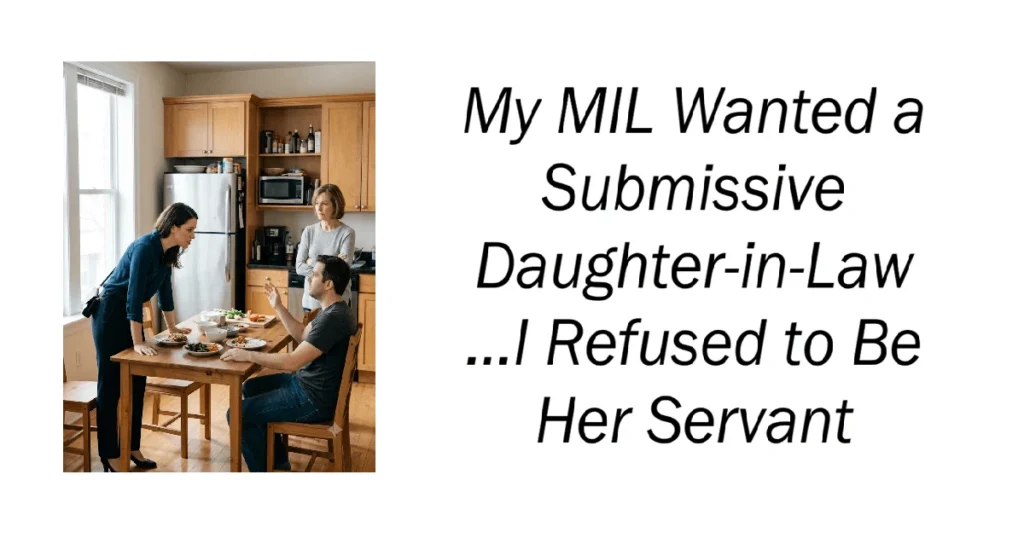
My MIL Wanted a Submissive Daughter-in-Law …I Refused to Be Her Servant
My husband grew up in a family where “traditional” meant one thing: his mother stayed home, raised the children, and took care of the house, while his father worked and provided for the family.
I grew up very differently.
My mother worked hard her entire life, and from an early age, she made one lesson clear to me:
“Never become financially dependent on a man.”
She wasn’t teaching me to distrust men. She was teaching me the importance of independence and having choices.
So when I got married, I never expected my husband to support me while I stayed home. I wanted a career, my own income, and a partnership in which we both contributed to our family.
Thankfully, my husband seemed to share that vision.
Although he had grown up watching his mother take care of everything, he worked hard to unlearn those expectations. He cooked, cleaned, helped with the children, and attended parent-teacher meetings. He never acted as though childcare or household responsibilities were exclusively a woman’s job.
For years, I genuinely believed we had found the perfect balance.
There was just one problem: my husband cared far too much about what his parents thought.
Whenever his mother made a comment about our lifestyle, he became uncomfortable. Whenever his father questioned our choices, my husband felt compelled to defend himself.
I understood wanting your parents to be proud of you. But sometimes, it felt as though their approval mattered more to him than mine.
My in-laws had never approved of me being a working mother. They thought I was too independent. They disapproved of my husband cooking dinner, disliked the fact that we hired a cleaner, and couldn’t understand why I didn’t define my entire identity around being a wife and mother.
To them, I was one of those “modern women” who had forgotten what a wife was supposed to be.
We had actually discussed this quite directly early in our marriage. I told them respectfully that I would never criticize how they chose to live their lives, but I expected the same respect in return.
“My home is my home,” I told them. “You’re welcome here, but you don’t get to tell me what kind of wife or mother I should be.”
For the most part, they respected that boundary.
At least, they did until they came to stay with us for two weeks.
Our routine was simple. I usually handled breakfast, everyone ate lunch at work or school, and my husband cooked dinner.
We normally had a cleaner who kept the house in order, but she happened to be on holiday during my in-laws’ visit. My husband and I simply cleaned up after ourselves, as we always had.
There was nothing unusual about our arrangement, and I saw no reason to change it just because we had guests.
Then yesterday, everything changed.
I arrived home from work at around 6:20 p.m., exhausted and starving. As usual, I took a quick shower before heading downstairs to help get dinner ready. We normally ate at seven, so I assumed my husband would already have started cooking.
But when I walked into the kitchen, I immediately noticed something was wrong.
Nothing had been prepared.
There was no food on the counter, no dishes ready, and no sign that anyone had even thought about dinner.
I looked at my husband.
“What happened? Are we not having dinner?”
He avoided my eyes.
Before he could answer, his mother spoke.
“He didn’t cook tonight.”
I waited, expecting her to explain what had happened.
Instead, she looked directly at me and said, “So now you need to do your duty as a wife and cook for your family.”
I stared at her, then turned back to my husband.
He still wouldn’t meet my eyes.
And suddenly, I understood.
This wasn’t an accident or a change of plans. They had deliberately waited for me to come home, expecting me to walk into the kitchen, put on an apron, and prove that I could still be the kind of wife they believed I should be.
I didn’t argue. I didn’t raise my voice.
I simply picked up my phone and ordered takeaway.
When the food arrived, I served myself and the children, then sat down at the table. My husband and his parents eventually joined us.
That was when my mother-in-law began her lecture.
She talked about how women used to take pride in caring for their homes. She complained that modern women were too focused on their careers and insisted that children needed mothers who were actually present.
Then she looked directly at me.
“You’re a failure as a wife.”
I put down my fork and turned to my husband.
“Do you have anything to say?”
For a moment, I thought he might defend me. I thought he might remind his mother that the life we had built together was something we had both chosen.
Instead, he sighed.
“Mom has a point.”
I felt something inside me crack.
“It wouldn’t hurt for you to act more like a proper woman,” he continued.
He told me I needed to take better care of our home. He said traditions existed for a reason.
Then he said something that hurt more than anything else.
“You act like you’re too good for the way I was raised.”
I couldn’t believe what I was hearing.
After everything we’d built together, after years of sharing responsibilities and creating a partnership based on equality, he was suddenly telling me I was failing because I refused to become his mother’s version of a wife.
I looked at his parents, then back at him.
And finally, I snapped.
“Tradition doesn’t allow a man making $35,000 a year to support a family of five.”
The room fell silent.
Then I added something I immediately regretted saying in front of the children.
“And you’re too broke to be this sexist.”
My husband’s expression changed instantly.
His eyes filled with tears. He pushed his chair back, stood up, and quietly left the table.
Nobody said a word.
For a few seconds, I sat there staring at my food, still running on adrenaline. But as the anger began to fade, it was replaced by something much heavier.
Exhaustion. And regret.
Not because I believed my point was entirely wrong, but because of the way I’d made it, especially in front of our children.
I knew I’d hurt my husband. I also knew his mother would probably use that moment to reinforce everything she’d always believed about me.
But there was something else I couldn’t ignore.
For years, my husband had worked hard to prove that he wasn’t his father. He had chosen to be an equal partner. He had chosen to cook, to care for our children, and to share the responsibilities of running a household.
He had chosen a different life.
Yet the moment his parents sat at our table and challenged that life, he seemed willing to abandon everything we’d built together just to win his mother’s approval.
That hurt more than her insults ever could.
Later that night, I found him sitting alone. His eyes were still red.
I sat down beside him and apologized for what I’d said in front of the children.
But I also made it clear that I wouldn’t apologize for refusing to live according to someone else’s definition of a “proper woman.”
I told him I loved him. I told him I respected the effort he’d made to break away from the beliefs he’d grown up with. I knew it couldn’t have been easy to question the values he’d been taught his entire life, and I had never expected him to get everything right.
But if he wanted to return to those traditions, that was his choice.
He couldn’t force me to live by them, too.
Then I told him something I had never imagined needing to say to my own husband.
“If you want a traditional wife, you need to decide whether you actually want me.”
He didn’t answer immediately. He just sat there quietly, and I left him to think about what I’d said.
For the first time since we got married, I realized that our biggest problem wasn’t my mother-in-law or even her outdated expectations.
It was whether my husband would continue choosing the life we’d built together or return to living for his parents’ approval.
Because tradition may explain where someone comes from, but it shouldn’t determine who they are allowed to become.
And it certainly shouldn’t be used as an excuse to dictate what another person must sacrifice to make everyone else comfortable.
You’ve just read My MIL Wanted a Submissive Daughter-in-Law. Why not read Simple Trick for Cleaning Oven Door Glass