
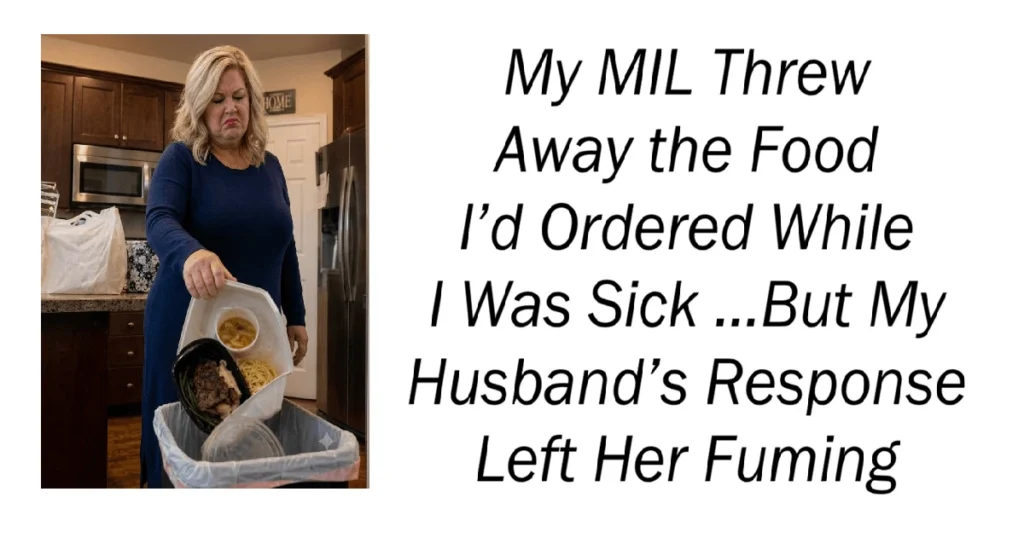
My MIL Threw Away the Food I’d Ordered While I Was Sick …But My Husband’s Response Left Her Fuming
By five o’clock that evening, sitting up felt like fighting gravity.
I’d spent most of the day under two blankets despite sweating through my T-shirt, sipping lukewarm water because anything cold hurt my throat.
Nathan had wanted to stay home that morning.
“Yoli, I’m serious. I can call in.”
“You have that quarterly meeting.”
“I also have a wife with a fever.”
“I have medicine, water, and a TV remote. Go.”
He kissed my forehead, refilled my water bottle, set my medicine beside the bed, and pointed at me.
“Stay in bed. And order dinner. Don’t even look at the stove.”
“Yes, sir.”
At 4:30, the kids came home hungry. I ordered pasta for them, steak and potatoes for Nathan, and chicken soup for myself.
I texted Nathan.
Your dinner costs more than my medicine.
His reply came immediately.
Worth it. Stay upstairs, Yoli. ❤️
Ten minutes later, I heard the front door open.
Angela.
Nathan’s mother never knocked when she knew we were home.
A few minutes later, she appeared in my bedroom doorway.
She looked me over.
“It’s five o’clock, Yolanda. And you’re still in bed?”
“I have a fever, Angela.”
She pressed two fingers to my forehead.
“You always did get dramatic when you’re sick.”
Angela had a talent for making insults sound casual.
During my marriage to Nathan, she’d criticized my cleaning service after our second child was born, commented that ironing took five minutes if I cared how my husband looked, and once tasted my lasagna before saying, “At least the children seem to like it.”
Nathan usually rolled his eyes.
“That’s just Mom.”
I usually let it go.
That day, I shouldn’t have.
The doorbell rang.
“That’s dinner,” I said. “Could you bring it in?”
“Dinner?”
“I ordered food.”
“You ordered it?”
“Yes.”
Ten minutes passed.
Then fifteen.
No one brought me my soup.
Finally, I forced myself downstairs.
My legs were wobbling by the time I reached the kitchen.
Angela stood beside the trash can.
Inside were the restaurant containers.
The pasta.
Nathan’s steak.
The side dishes.
Even my unopened soup.
“Angela?”
She wiped her hands on a paper towel.
“What are you doing?”
“Saving my son from eating that garbage.”
“You threw it away?”
“Of course.”
“Why?”
She gestured toward the stove.
“Because someone around here needs to remember what a kitchen is for.”
“That was $90 of food.”
“Because someone around here needs to remember what a kitchen is for.”
“Angela, I’m sick.”
“So?”
“Nathan told me to order dinner.”
“Of course he did. He babies you.”
Then she crossed her arms.
“A good wife cooks dinner herself.”
I stared at the trash.
“You threw away my soup too.”
“You need soup? There’s a saucepan.”
“Get up and make dinner yourself.”
I sank into a kitchen chair.
One of the kids appeared in the doorway.
“Mom, can I have crackers?”
“Yeah, honey.”
Angela sighed.
“Crackers for dinner. Wonderful.”
I looked at her.
“Please stop talking.”
She looked genuinely offended.
“I came here to help.”
“No, you didn’t.”
Twenty minutes later, the front door opened.
“Yoli?”
Nathan walked into the kitchen and stopped.
The kids were eating crackers and peanut butter. I was sitting at the table, crying because I felt terrible, hungry, and completely drained.
Nathan looked around.
“Where’s dinner?”
Angela answered.
“In the trash.”
Nathan slowly lowered his laptop bag.
He looked inside.
His untouched steak was sitting on top of my soup.
“Mom, did you do this?”
Angela lifted her chin.
“Someone had to remind your wife what marriage means.”
Nathan stared at her.
Then, strangely, he smiled.
“You know what, Mom? You’re absolutely right.”
I looked at him.
“Nathan?”
He raised a hand.
“Actually, thank you.”
Angela relaxed.
“For what?”
“For looking out for me.”
Nathan pulled out his phone.
“I just need to make one call.”
He stepped into the hallway.
“Aunt Irene?”
Angela froze.
Nathan continued.
“Yeah, it’s me. Do you still have that old Tuesday dish you always joke you should’ve thrown out twenty years ago?”
Angela stood.
“Nathan?”
He ignored her.
“Perfect. Can you bring it over with some of the old Tuesday dinner?”
“Twenty minutes? Great.”
He ended the call.
Angela stared at him.
“What are you doing?”
“Getting someone a second opinion.”
“You’ll see.”
He made sandwiches for the kids while Angela followed him around, demanding that he stop.
He didn’t.
For once, she had nothing to say.
Twenty minutes later, the doorbell rang.
Nathan opened it.
“Aunt Irene!”
A silver-haired woman in her seventies stepped inside carrying an old rectangular casserole dish. It was scratched, one handle had been repaired with dark tape, and a strip of yellowed masking tape ran across the lid.
Angela went pale.
“What is she doing here?”
Irene looked at her.
“Well, hello.”
Nathan took the dish from her and placed it on the table.
“You said a good wife cooks dinner herself,” he told his mother. “I thought Yoli should meet the woman who cooked for us.”
Angela’s face flushed.
“How could you do this to your own mother?”
Nathan pointed to the faded label on the dish.
I leaned closer.
Two words were still visible:
ANGELA — TUESDAY
Irene rested her hands on the casserole dish.
“For almost a year, your mother came to my back door at least twice a week.”
Angela looked away.
“I had a lot going on.”
“Exactly,” Irene said.
Nathan stared at the label.
“Tuesday?”
“Chicken and rice,” Irene replied. “Thursday was usually soup.”
I looked at Angela.
She had spent years describing Nathan’s childhood as though she’d carried every burden alone.
“One night, Nathan had pneumonia,” Irene continued. “Angela hadn’t slept properly in two days. She came over crying and said, ‘I can’t keep up.’”
Angela said nothing.
“I gave her dinner and told her, ‘Feed your boy. Nobody said you had to stir every pot yourself.’”
Angela finally spoke.
“I cooked plenty too.”
“I know you did,” Nathan said.
He opened the casserole dish and smiled at the smell.
Then he looked toward the trash.
“So explain something, Mom. If Irene feeding me didn’t make you less of a mother, why did Yoli ordering dinner make her less of a wife?”
Angela hesitated.
“That was different.”
“How?”
“I was overwhelmed.”
I looked at her.
“So am I.”
Irene asked quietly, “When I fed Nathan, did you love him less?”
Angela had no answer.
Nathan finally said, “Mom, you’re going home. And from now on, call before you come over.”
Angela looked wounded.
“You’re throwing me out?”
“You threw away my kids’ dinner and told my sick wife to cook. That isn’t concern.”
She turned toward me.
“I only wanted Nathan taken care of.”
“You threw away soup meant for someone with a fever,” I said. “Whatever lesson you thought you were teaching, it wasn’t about taking care of anyone.”
Nathan helped me upstairs.
He didn’t leave me to smooth things over with his mother.
That meant more to me than he probably realized.
The next morning, Angela called first.
Nathan answered.
Ten minutes later, there was a soft knock on our bedroom door.
Angela stood there holding a bowl.
“May I come in?”
I nodded.
“Soup.”
I looked at the bowl.
“You made that?”
She paused.
Then, perhaps for the first time, she gave someone else the credit.
“No. Irene did.” She set it beside me. “I brought it.”
“Thank you.”
Angela turned to leave, then noticed my empty water glass.
Without a word, she picked it up.
A minute later, she returned with it full and placed it beside my medicine.
“Anything else?”
Yesterday, she’d told me to get up and serve everyone.
Today, she stood beside my bed asking what I needed.
“Could you close the curtains?”
She nodded and pulled them shut.
Then she picked up Irene’s old casserole dish and carried it downstairs.
For the first time, Angela wasn’t telling me how to be a good wife.
She was learning how to be a good mother-in-law.
You’ve just read My MIL Threw Away the Food I’d Ordered While I Was Sick. Why not read Why Do Your Fingers Turn White or Blue in the Cold