
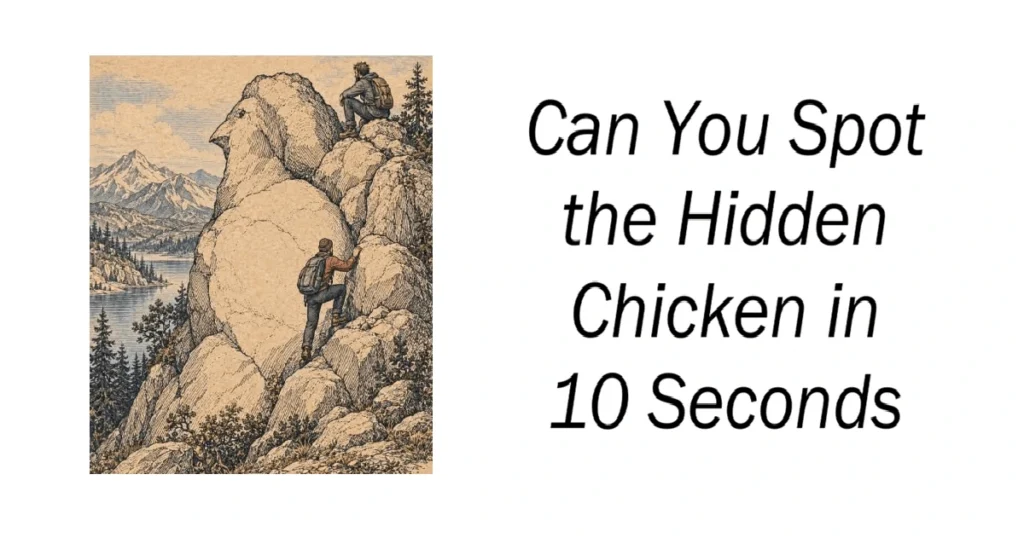
Can You Spot the Hidden Chicken in 10 Seconds
At first glance, this picture looks surprisingly ordinary: two men, a rocky cave, and a collection of shadows and uneven stone formations.
But there’s a catch.
A chicken is hiding somewhere in the image—and you have just 10 seconds to find it.
Ready?
Take a close look before scrolling down to the answer.
The Hidden Chicken Challenge
Most people begin by scanning the center of the image.
That seems logical. We naturally expect a hidden object to stand out once we know what we’re searching for. But after a few seconds, something strange happens.
The rocks, shadows, and irregular shapes begin to compete for your attention.
Suddenly, what looked like a simple picture becomes a surprisingly difficult visual puzzle.
If you haven’t spotted the chicken yet, don’t worry. You’re not necessarily missing it because you have poor eyesight.
There’s something else going on.
Why Is the Chicken So Difficult to See?
The challenge has a lot to do with how our brains process visual information.
We don’t examine every single detail of an image equally. Instead, our attention automatically prioritizes certain things.
Human faces, strong contrasts, familiar objects, movement, and areas that appear important tend to attract our attention first.
Meanwhile, smaller shapes that blend into their surroundings can be surprisingly easy to overlook—even when they’re technically right there in front of us.
That’s why one person might spot the chicken almost immediately while another can stare at the same picture for several minutes without seeing it.
Still Searching? Try This Trick
If you’re still looking, don’t examine every rock with intense concentration.
Instead, try relaxing your eyes.
Step back from the screen slightly. Let your gaze move across the entire picture rather than focusing on one tiny area.
You can also try looking at the image from a slightly different angle.
Sometimes, staring too hard actually makes the hidden shape more difficult to recognize because your brain becomes locked into its original interpretation of what it’s seeing.
Before you give up, there’s one part of the image you may not have examined carefully enough.
The Answer: Where Is the Chicken?
Look toward the edge of the cave, among the rocks.
The chicken’s outline blends into the surrounding stone formations, making it remarkably easy to overlook.
At first, your brain interprets the shapes as nothing more than rocks and shadows.
But once you recognize the chicken, something fascinating happens.
You suddenly wonder: “How did I not see that before?”
And that’s exactly what makes hidden-object puzzles so satisfying.
Your Brain Isn’t Seeing Everything You Think It Is
This little challenge is a great example of selective attention.
Your brain is constantly processing an enormous amount of visual information, but it can’t give equal attention to everything. Instead, it filters the scene and focuses on what appears most relevant.
That filtering is extremely useful in everyday life.
But sometimes it works against us.
When a hidden object has a similar shape, color, or texture to its surroundings, the brain may effectively categorize it as background information.
The object isn’t invisible.
Your attention simply isn’t prioritizing it.
Did You Find It in 10 Seconds?
If you spotted the chicken almost immediately, congratulations!
If you needed the full 10 seconds—or even longer—don’t worry. These puzzles are designed to exploit the way our visual attention works.
And there’s something wonderfully satisfying about that moment when the hidden shape finally clicks into place.
You can look at the same picture dozens of times, see nothing unusual, and then suddenly…
There it is.
The chicken was never truly hidden.
Your brain was simply looking somewhere else.
So, how quickly did you find it?
2 seconds? 5 seconds? The full 10? Or did you need the answer?
Either way, this little puzzle is a fascinating reminder that sometimes the things we overlook aren’t actually out of sight—they’re simply hiding in plain sight.
You’ve just read Can You Spot the Hidden Chicken. Why not read Can You Safely Leave Butter on the Counter