
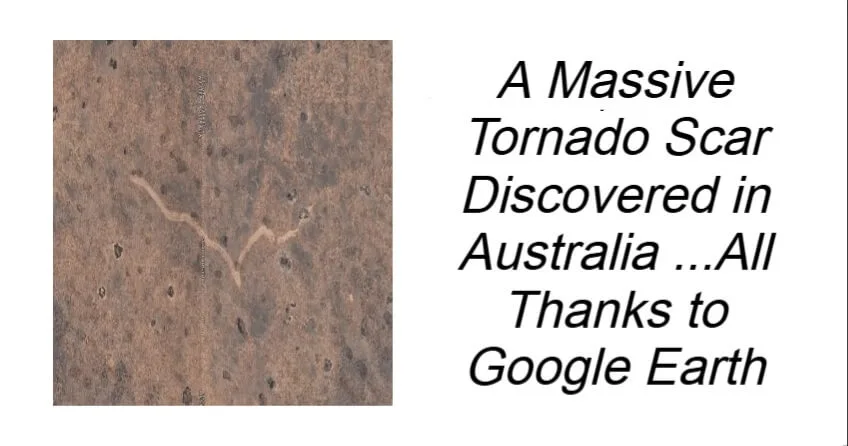
A Massive Tornado Scar Discovered in Australia …All Thanks to Google Earth
While casually exploring Google Earth, a caver studying Australia’s Nullarbor Plain stumbled upon something extraordinary. What initially looked like a minor blemish on the landscape turned out to be an enormous scar—11 kilometers long and 250 meters wide—etched across one of the most remote regions on the continent.
The unexpected discovery immediately caught the attention of scientists and sparked new research into extreme weather events in areas so isolated they’re rarely observed firsthand.
A Discovery That Raised More Questions Than Answers
Dr. Matej Lipar, an adjunct research fellow at Curtin University’s School of Earth and Planetary Sciences, described his reaction with disbelief. “This scar was a remarkable find,” he said. “Its sudden appearance was a real puzzle.”
Located roughly 20 kilometers north of the Trans-Australian Railway, the sheer size and clarity of the mark suggested it wasn’t a geological anomaly. That realization led Dr. Lipar and his team to organize an expedition to investigate the site in person.
Clear Evidence of a Powerful Tornado
On the ground, the team identified distinct cycloidal patterns—curving marks formed by tornado suction vortexes. These patterns confirmed the cause: a powerful tornado that likely rated F2 to F3 on the Fujita scale, with wind speeds exceeding 200 kilometers per hour.
Based on the damage and spacing of the markings, researchers estimate the tornado lasted between seven and thirteen minutes, carving a dramatic path through the barren terrain.
Pinpointing When It Happened
By comparing satellite images taken before and after the event, scientists narrowed the tornado’s occurrence to a short window between November 16 and November 18, 2022.
Tornadoes are extremely rare in the Nullarbor Plain. In fact, only three have ever been documented in the region—and all occurred in November. “It’s fascinating that tornadoes here seem to form around the same time each year,” Dr. Lipar noted.
Why No One Noticed
The Nullarbor Plain is one of the most sparsely populated places on Earth. With few residents and little infrastructure, extreme weather events can easily go unwitnessed. “Because there are so few people in such an isolated area, many events like this go completely undocumented,” Dr. Lipar explained.
This is where modern technology proves invaluable. Without satellite imagery and tools like Google Earth, this massive tornado scar might have remained hidden forever.
A Rare Opportunity for Science
The newly discovered scar offers researchers a unique chance to study tornado behavior in a remote environment largely untouched by human activity. According to Dr. Lipar, examining the damage pattern could improve understanding of tornado dynamics and the atmospheric conditions that produce them in isolated regions.
A Reminder of Nature’s Reach
This discovery is a striking reminder that even the most remote landscapes are shaped by powerful natural forces. It also highlights how modern technology is transforming the way we explore and understand our planet—revealing hidden stories written across the Earth’s surface, waiting to be found.
You’ve just read, A Massive Tornado Scar Discovered in Australia. Why not read Manager Had To Hire A New Employee.