
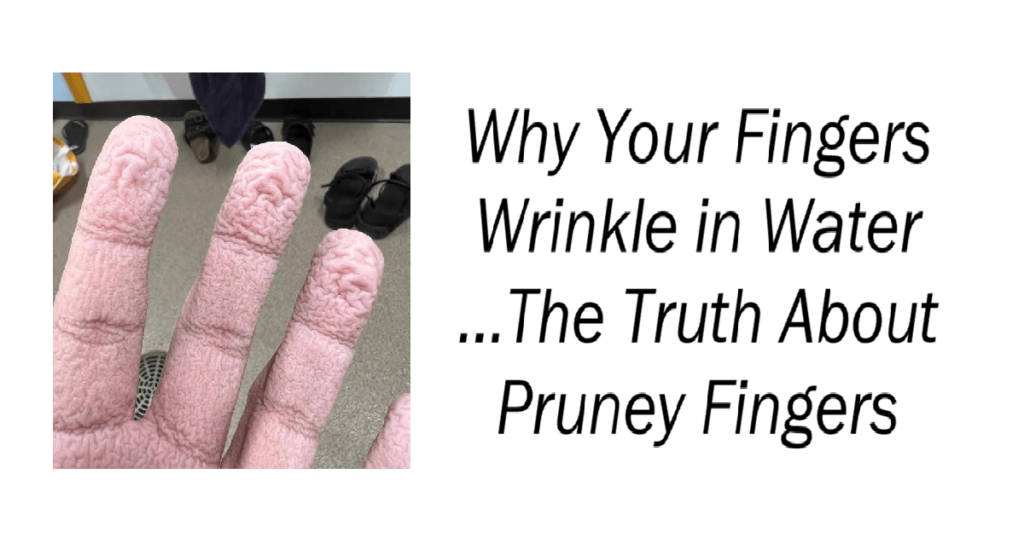
Why Your Fingers Wrinkle in Water ..The Truth About Pruney Fingers
Think back to the last time you spent a while in the pool, took a long bath, or washed a sink full of dishes.
You looked down at your hands and saw those familiar wrinkled fingertips. Like most people, you probably assumed your skin had soaked up water like a sponge.
It seems like the obvious explanation.
But it’s actually a myth.
Scientists now know that wrinkly fingers aren’t simply the result of your skin absorbing water. Instead, they’re caused by a fascinating response controlled by your nervous system—one that may have evolved to help you grip wet objects more effectively.
Your Fingers Aren’t Waterlogged
If your fingertips wrinkled simply because they absorbed water, the process would happen passively.
Instead, your body is actively making it happen.
When your hands or feet stay underwater for several minutes, your autonomic nervous system—the part of your nervous system that controls automatic functions like your heartbeat, breathing, and blood pressure—springs into action.
It signals the tiny blood vessels beneath the skin of your fingers and toes to narrow, a process called vasoconstriction.
Here’s what happens next:
- The blood vessels constrict.
- The volume of tissue beneath the skin decreases slightly.
- Because the outer layer of skin doesn’t shrink at the same rate, it folds into the familiar wrinkles you see.
Rather than swelling from water, your fingertips wrinkle because the tissue underneath changes shape.
Scientists Have Proof
One of the strongest pieces of evidence comes from people with nerve damage.
Researchers have found that individuals whose finger nerves have been injured often don’t develop water wrinkles in the affected fingers—even after prolonged soaking.
Without the nerve signals that trigger blood vessel constriction, the skin remains smooth.
This discovery helped confirm that wrinkling is an active biological response rather than a simple soaking effect.
Why Would Our Bodies Do This?
At first glance, wrinkled fingers seem like an odd design feature.
But researchers believe they may serve an important purpose.
Think of the tread on a car tire.
A smooth tire struggles on wet roads because water becomes trapped between the rubber and the pavement. Tire grooves channel water away, improving grip.
Scientists believe finger wrinkles may work in a similar way.
The tiny ridges create channels that allow water to drain away from the surface of your fingertips, helping improve traction when handling wet objects.
Does It Really Improve Your Grip?
Several laboratory studies suggest the answer is yes.
Participants with wrinkled fingers have been shown to pick up and move wet objects more quickly and efficiently than when their fingers were smooth.
Interestingly, this advantage appears only when objects are wet. When handling dry objects, wrinkled fingers offer little or no measurable benefit.
This has led researchers to believe the response may be an evolutionary adaptation that helped our ancestors gather food, climb wet rocks, or move safely through damp environments.
Why Don’t Our Fingers Stay Wrinkled All the Time?
If wrinkles improve grip, why doesn’t our body keep them permanently?
The answer is likely a trade-off.
Smooth fingertips provide excellent sensitivity and touch under normal conditions. Wrinkles appear only when needed, then disappear once the skin dries and blood flow returns to normal.
It’s an efficient system that gives us the best of both worlds.
The Bottom Line
The next time your fingers wrinkle after a swim or a long shower, remember—they’re not simply soaking up water.
Your nervous system is actively reshaping your fingertips by narrowing tiny blood vessels beneath the skin. Many scientists believe this temporary transformation helps improve your grip on wet surfaces, making it easier to hold slippery objects.
It’s a small reminder that even the simplest changes in our bodies often have surprisingly sophisticated explanations—and that evolution has equipped us with adaptations we rarely notice until we need them.
You’ve just read Why Your Fingers Wrinkle in Water. Why not read Always Tired Even After a Full Night’s Sleep