
At 56 My Widowed Grandmother Welcomed Twins …Then the Babies Changed Everything
When my grandmother announced she was pregnant at fifty-six, my family reacted as though someone had died.
Not quietly, either.
My mother locked herself in the kitchen and cried. My uncle paced endless circles around the dining room, muttering about humiliation and “what people would say.” My aunt called it selfish. My cousins whispered about dementia, loneliness, and a late-life crisis. Even relatives who hadn’t visited Grandma in years suddenly became experts on morality and biology.
Through all of it, my grandmother remained remarkably calm.
“I didn’t ask anyone else to raise them,” she said one evening as my mother slammed cabinet doors hard enough to rattle the dishes. “I only asked you not to hate me for it.”
Somehow, that made everyone even angrier.
Because she had done it entirely on her own.
There was no husband. No boyfriend. No secret relationship that could explain any of it.
My grandfather had died twelve years earlier after forty years of marriage. Grandma had never dated again. She still wore her wedding ring and still spoke to his framed photograph every morning while making coffee.
Without telling any of us, she had undergone IVF using both a donor egg and donor sperm.
She didn’t reveal the truth until she was already five months pregnant, standing in her garden wearing loose clothes that could no longer hide the growing bump beneath them.
I still remember the silence after she finished speaking.
Then my uncle laughed.
Not because it was funny.
Because he was convinced it had to be a joke.
It wasn’t.
The months that followed split the family in two.
Some relatives stopped calling altogether. My aunt refused to come for Thanksgiving if Grandma was there, insisting it would only “encourage the insanity.” My mother wasn’t angry in the same way—she was heartbroken. She couldn’t understand why someone approaching retirement would choose to start over when most people her age were becoming great-grandparents.
But Grandma never seemed ashamed.
That was what unsettled everyone most.
She painted two small bedrooms herself. She ordered cribs, knitted tiny yellow blankets while old jazz records played, and attended every doctor’s appointment alone. Even when walking became difficult and every trip to the grocery store left her exhausted, she never complained.
Every Sunday morning, she still set three plates on the breakfast table before quietly putting one back into the cupboard.
One for herself.
One for my grandfather.
“And now,” she said to me one morning with a soft smile, “maybe two more for the house.”
“You really aren’t scared?” I asked one evening while helping her fold tiny baby clothes.
She smiled without looking up.
“Oh, sweetheart,” she said gently, “I’ve already survived the worst thing.”
She meant losing my grandfather.
No one argued after that.
Last week, she finally went into labor.
Twins.
Despite months of arguments and silence, somehow the entire family ended up at the hospital. Maybe when something irreversible is happening, anger suddenly feels less important.
The waiting room was painfully quiet.
No one knew where to sit. No one knew what to say.
My mother stared at the floor. My uncle kept unlocking his phone only to stare blankly at the screen.
Finally, a nurse appeared.
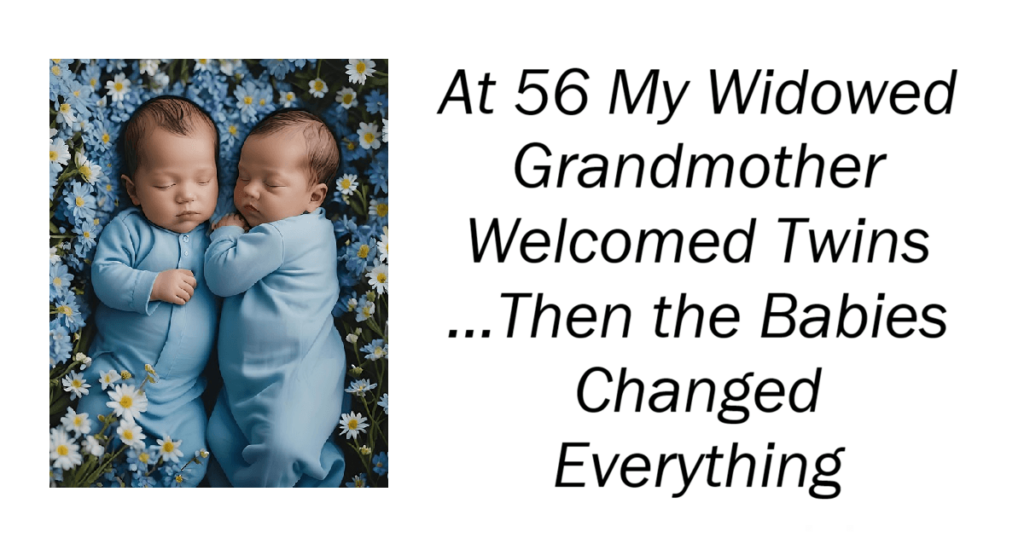
“They’re healthy,” she said with a warm smile. “Both boys.”
The entire room seemed to exhale at once.
When we entered Grandma’s room, she looked exhausted beyond words.
Pale.
Fragile.
Smaller somehow.
But peaceful.
The nurse carefully placed one baby in each of her arms.
One wrapped in blue.
The other in white.
Then Grandma froze.
Completely still.
Slowly, she lifted her eyes toward my mother.
“I know whose they are,” she whispered.
My mother gripped my arm so tightly it hurt.
Because the babies looked exactly like my grandfather.
Not vaguely.
Not in the way grieving families convince themselves they see familiar faces.
Exactly.
The same deep-set eyes.
The same stubborn little mouth.
Even the same quiet, thoughtful expression he always wore in photographs, as though he knew something no one else did.
One of the twins even had the tiny crease near his chin that had passed from my grandfather to my uncle and then to my cousin.
No one spoke.
I looked around the room and realized every person was crying.
Even my uncle.
Grandma gazed at the boys for a long moment before tears finally rolled down her cheeks.
“I always told him,” she whispered, her voice trembling, “that I’d keep the house full.”
My mother broke first.
She sat beside the bed and buried her face against Grandma’s shoulder like she was a little girl again.
My aunt quietly wiped away tears by the window.
Months of resentment suddenly felt small, foolish, and impossibly distant.
Of course we knew genetics don’t work like magic.
Of course we knew the resemblance was nothing more than an extraordinary coincidence.
But grief has a way of reshaping what people feel.
And love has a way of making those feelings matter.
That evening, everyone gathered at Grandma’s house.
The cousins brought food.
My uncle finally fixed the porch light that had been broken for six months.
My mother rocked one baby while my aunt held the other.
Laughter filled rooms that had echoed with silence for years.
The house felt alive again.
And in the middle of it all sat my grandmother, holding both boys against her chest with the calmest expression I’d ever seen.
Not triumphant.
Not defensive.
Just quietly certain.
Like a woman who had known, from the very beginning, exactly what she was doing.
You’ve just read At 56 My Widowed Grandmother Welcomed Twins. Why not read Why Your Fingers Wrinkle in Water