
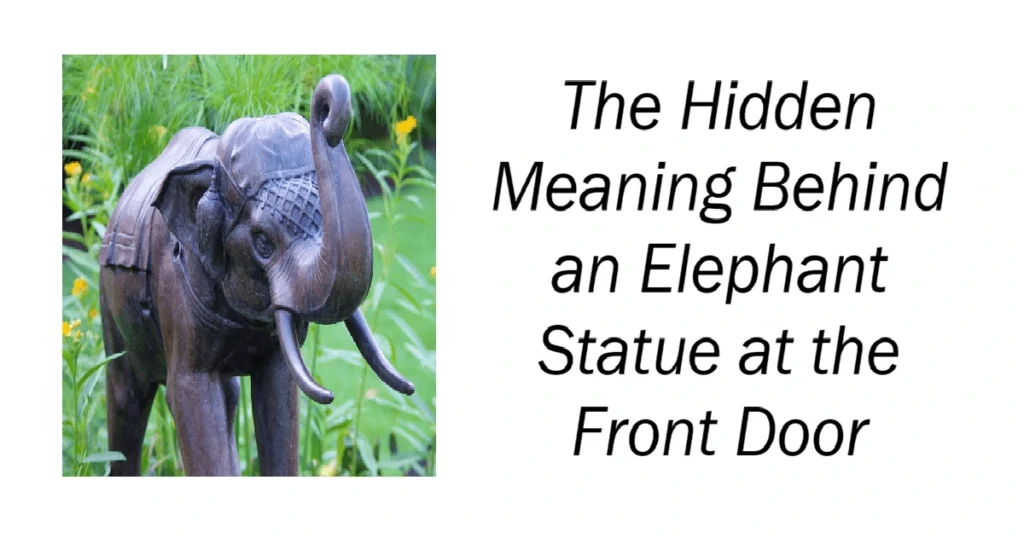
The Hidden Meaning Behind an Elephant Statue at the Front Door
Have you ever seen a house with an elephant statue by the front door and immediately wondered what was going on?
Not as part of a themed garden. Not next to a matching set of decorations. Just… an elephant. Standing there like it has an important job.
My sister and I spotted one years ago and completely stopped in our tracks.
“What is that doing there?”
It wasn’t creepy exactly. Just oddly specific. The kind of thing that feels intentional even when you can’t figure out why.
At first, we assumed it was just someone’s decorating choice. But the more we looked, the more it felt like there had to be a story behind it.
As it turns out, there usually is.
More Than Just a Decoration
For some homeowners, an elephant statue is simply a piece of garden décor. They liked the way it looked, found it at a garden center, or thought it added a bit of personality to the front porch.
But elephants have carried symbolic meaning for centuries, and placing one near an entrance is often very deliberate.
A lot of that symbolism comes from Feng Shui, the traditional Chinese practice of arranging spaces to encourage balance and positive energy.
The basic idea is that the way a home is organized influences the flow of energy—or chi—through the space. Certain objects are believed to attract specific qualities, and elephants are considered especially powerful symbols.
They are commonly associated with strength, wisdom, protection, stability, and good fortune.
Which explains why so many of them end up standing guard by front doors.
Why the Direction Matters
In Feng Shui, the direction an elephant faces is often considered important.
An elephant facing outward, toward the street or entrance, is believed to attract good fortune and positive energy into the home. Think of it as welcoming opportunities and blessings from the outside world.
An elephant facing inward serves a different purpose. Rather than drawing something in, it symbolizes protection, helping safeguard the family and the good fortune already inside.
Then there’s the trunk.
A raised trunk is traditionally associated with luck, prosperity, and positive energy. It’s the version most commonly recommended for entrances.
A lowered trunk has different interpretations depending on the tradition. Some associate it with fertility, longevity, or accumulated wisdom rather than active good fortune.
Either way, people have surprisingly strong opinions about elephant trunks.
A Symbol Found Around the World
Elephants aren’t significant only in Feng Shui.
In India, elephants are closely connected with spiritual symbolism through Ganesha, the elephant-headed deity widely associated with wisdom, success, and the removal of obstacles.
Beyond specific religious traditions, elephants have developed a broader symbolic reputation almost everywhere they appear.
They are seen as intelligent, patient, loyal, and emotionally complex. Whether or not every popular belief about elephant memory is true, the animal has become a powerful symbol of resilience and wisdom.
There’s something about elephants that people instinctively trust.
They’re strong without seeming aggressive. Powerful without appearing chaotic.
That combination has made them enduring symbols across cultures for generations.
And Sometimes It’s Just Décor
Of course, not every elephant statue arrives on a front porch carrying centuries of symbolism.
Sometimes it’s just décor.
You can find elephant statues almost anywhere now—garden centers, home stores, online marketplaces, and design websites. They’ve become one of those decorative pieces people gravitate toward because they feel warm, welcoming, and a little distinctive.
And that’s perfectly fine.
Not every decorating decision needs a deeper meaning.
Sometimes a homeowner simply sees an elephant statue and thinks, “That would look nice by the front door.”
But what’s interesting is that even when people buy them purely for aesthetic reasons, they’re often choosing a symbol that has carried ideas of luck, protection, and wisdom for hundreds of years.
Whether they realize it or not, they’re participating in a tradition that’s much older than the statue itself.
So What Does It Really Mean?
The honest answer is that it depends.
Maybe the elephant is there for luck.
Maybe it’s there for protection.
Maybe it was recommended by a family member, inspired by a cultural tradition, or chosen because it happened to be on sale.
But the reason so many people pause when they see one is that an elephant statue never feels completely random.
It feels like it means something.
And perhaps that’s why the tradition has lasted.
A front-door elephant stands quietly in the background, asking for nothing while symbolizing strength, stability, and good fortune.
Or maybe it’s just a statue.
Either way, it’s probably doing exactly what its owner hoped it would do.
You’ve just read Meaning Behind an Elephant Statue at the Front Door . Why not read Should Customers Clean Up After Themselves