
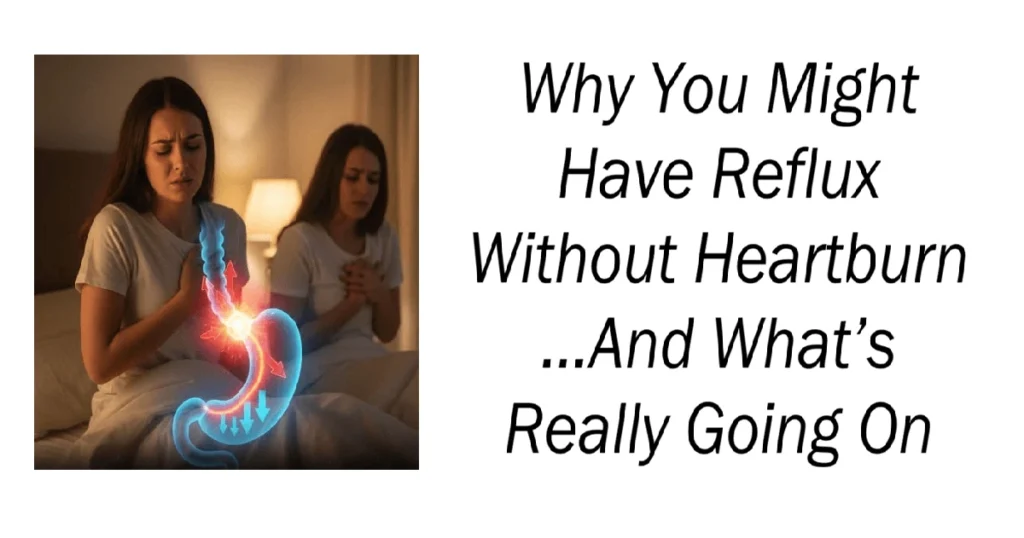
Why You Might Have Reflux Without Heartburn …And What’s Really Going On
Do you ever feel a burning sensation after eating? Or maybe you don’t have heartburn at all—but instead deal with a constant lump in your throat, sticky mucus, or the need to clear your throat before speaking?
At first glance, these symptoms seem unrelated. One is labeled “acid reflux,” the other often blamed on allergies, stress, or even nerves.
But in many cases, they share the same root cause: a valve in your body that isn’t working as it should.
It’s Not Just About Acid
Here’s a surprising truth: reflux isn’t always caused by too much stomach acid.
More often, it’s a mechanical issue—specifically, a problem with the lower esophageal sphincter (LES). This small ring of muscle acts like a one-way valve between your stomach and esophagus.
When it’s working properly, it keeps stomach contents where they belong. When it weakens or relaxes at the wrong time, acid and gas can travel upward—causing symptoms whether you feel heartburn or not.
That’s why you can experience reflux without the classic burning sensation.
Why Quick Fixes Aren’t the Full Answer
You might already know a few fast remedies—like taking antacids or even using baking soda for relief.
They can help in the moment. But they don’t address the root problem.
Medications that reduce stomach acid may ease irritation, but they don’t fix the underlying issue: the valve itself.
And here’s something important—stomach acid isn’t the enemy. It plays a crucial role in:
- Digesting proteins
- Absorbing nutrients like vitamin B12
- Protecting against harmful bacteria
The real issue is location, not presence. Acid becomes a problem only when it travels where it shouldn’t.
Understanding Your Stomach: It’s All About Pressure
Think of your stomach less like a simple bag and more like a pressurized container.
Imagine a balloon filled with liquid and air. If you squeeze it, pressure builds—and the contents push upward.
Your lower esophageal sphincter is like the knot of that balloon. It’s designed to keep everything contained.
But several things can weaken or overwhelm it:
- Excess pressure from overeating
- Gas and bloating
- Improper muscle relaxation
- Structural issues like a hiatal hernia
When that pressure becomes too strong, the valve opens—and reflux happens.
The Most Common Mistake: Overfilling Your Stomach
One of the biggest triggers for reflux is surprisingly simple: eating too much.
When your stomach becomes overly full, pressure increases. And pressure, by nature, looks for a way out.
That’s where the “80% rule” comes in.
Instead of eating until you’re completely full, aim to stop when you feel about 80% satisfied. This small shift can significantly reduce internal pressure—and give your body a better chance to keep that valve closed.
Simple Habits That Can Make a Big Difference
If reflux is partly mechanical, then small physical changes can have a real impact.
Here are a few practical strategies:
Use Gravity to Your Advantage
- Avoid lying down for 2–3 hours after eating
- Sleep on your left side
- Slightly elevate the head of your bed
These changes help keep stomach contents where they belong.
Be Mindful of What Relaxes the Valve
Some foods and substances can chemically relax the LES, making reflux more likely. Common culprits include:
- Mint
- Chocolate
- Alcohol
- Tobacco
Temporarily reducing or eliminating these can give your body a chance to recover.
Rethink How You Eat and Drink
- Avoid large amounts of liquid during meals
- Eat slowly to reduce air swallowing
- Pay attention to portion sizes
These habits help prevent unnecessary pressure buildup.
The Bigger Picture
Reflux isn’t always about excess acid—it’s often about control, pressure, and timing.
Understanding this shifts the focus from just suppressing symptoms to actually addressing the cause.
By supporting your body mechanically—through posture, eating habits, and awareness—you can often reduce symptoms and rely less on temporary fixes.
Final Thought
If you’ve been treating reflux as purely an acid problem, you might be missing half the story.
Sometimes, it’s not about what’s in your stomach—it’s about whether your body can keep it there.
And that’s something you can start improving, one small habit at a time.
You’ve just read Why You Might Have Reflux Without Heartburn. Why not read Why Earwax Buildup Happens