
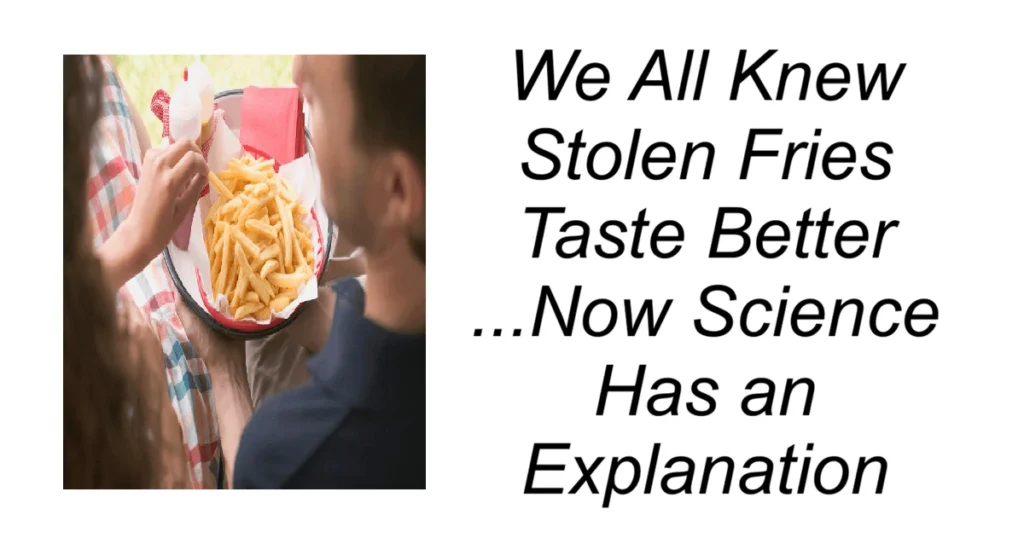
We All Knew Stolen Fries Taste Better …Now Science Has an Explanation
We’ve all been there. Someone orders a plate of golden, crispy French fries, and suddenly, their food looks far more appealing than the identical portion sitting right in front of us. Somehow, that one stolen fry tastes better than an entire serving of our own.
It turns out there may be more to this familiar experience than simple temptation. Researchers have investigated the psychology behind stealing food from someone else’s plate, and their findings suggest that the thrill of getting away with it can make the food taste even better.
Scientists Put Food Theft to the Test
Scientists around the world are working on major challenges, from developing cancer treatments to advancing renewable energy. But some researchers are also exploring everyday mysteries that most of us have experienced without giving them much thought.
One such question is deceptively simple: Does food taste better when we take it from someone else’s plate?
A study published in the journal Food Quality and Preference explored how the circumstances surrounding a meal can influence the pleasure we get from eating.
Previous research has shown that factors beyond the food itself can affect our experience of taste. Music, sounds, presentation, and even our surroundings can change how we perceive flavour and texture.
However, the researchers noted that relatively little attention had been paid to the effect of moral transgression — in other words, doing something we know we probably shouldn’t — on the enjoyment of everyday food.
To investigate, the researchers designed an experiment involving one of the world’s most popular snacks: French fries.
Participants were asked to take fries from another person’s plate under different experimental conditions. After eating them, they reported their emotional reactions, including feelings of guilt and excitement, as well as how much they enjoyed the food.
The results were intriguing.
The researchers found that taking the fries covertly increased reported enjoyment. What’s more, the perceived risk of being caught appeared to play a role. When the person guarding the plate was more watchful or stern, participants reported greater enjoyment of the stolen food.
In other words, the extra thrill of sneaking a fry may have made the experience more satisfying.
The Psychology of Forbidden Food
Why would a stolen French fry taste better than one taken from your own plate?
One possible explanation is the psychological phenomenon known as the forbidden fruit effect.
The basic idea is straightforward: when something is restricted, prohibited, or difficult to obtain, it can become more appealing.
This response isn’t limited to food. People may become more interested in things they are told they cannot have, whether that’s a tempting dessert, a prohibited activity, or a product marketed as exclusive.
Food provides a particularly interesting example. Research into children’s responses to restricted treats and food marketing suggests that limiting access can sometimes increase the appeal of the very thing being withheld.
The stolen-fries experiment offers another possible illustration of this principle. Taking food that technically belongs to someone else introduces an element of excitement and mild transgression that simply reaching into your own packet does not.
As the researchers suggest, indulgence accompanied by a degree of guilt may sometimes be more enjoyable than indulgence without those feelings.
Of course, that doesn’t mean guilt always makes food taste better. The effect depends on the situation, the individual, and the emotions involved.
Why the Fries Seemed Crispier, Saltier, and Fresher
Perhaps the most interesting part of the experiment is that the experience wasn’t just about getting away with something.
Participants’ perceptions of the fries were also influenced by the circumstances in which they ate them. The stolen fries were described as more appealing in qualities such as saltiness, crispiness, and freshness.
This highlights an important distinction between the physical properties of food and our perception of those properties.
A French fry doesn’t suddenly acquire more salt or become objectively crispier simply because someone else owns it. However, our brains do not experience flavour in isolation. Expectations, emotions, attention, and context all help shape how we perceive what we eat.
When an experience feels exciting or unusual, we may pay closer attention to it and enjoy it more. The food itself may be identical, but the experience surrounding it is different.
That is one reason the psychology of eating is so fascinating: taste is not simply a matter of ingredients and cooking techniques.
Why Someone Else’s Sandwich Can Taste Better
The stolen-fries experiment is part of a much broader story about how our minds influence our enjoyment of food.
Consider another familiar experience: a sandwich prepared by someone else often seems more appealing than one we’ve made ourselves.
There may be several reasons for this. When we prepare our own food, we see every ingredient and anticipate the finished result throughout the process. By the time we sit down to eat, some of the novelty may have disappeared.
When someone else makes the sandwich, we experience the finished product without having spent time assembling it. The element of surprise, the convenience, and the care involved in its preparation can all contribute to our enjoyment.
The difference isn’t necessarily in the sandwich itself. It may be in our expectations and the experience of receiving it.
Why Leftovers Sometimes Taste Better the Next Day
Another food mystery many people recognise is that certain dishes taste better after spending a night in the fridge.
Curries, stews, casseroles, and soups can develop a more rounded flavour as they sit. This can happen because ingredients continue to interact, flavours become more evenly distributed, and aromatic compounds change over time.
Texture can change, too. Starches may firm up or reorganise as food cools, while moisture moves between ingredients.
Not every dish improves with storage, and food safety still matters. But when a recipe benefits from these changes, the result can taste more cohesive and satisfying the following day.
Once again, the enjoyment of food depends on more than its original ingredients. Time and context can make a meaningful difference.
Is There Really Such a Thing as a Dessert Stomach?
Then there’s the familiar phenomenon that occurs after a large meal: you feel completely full, yet somehow still have room for dessert.
This experience is sometimes described as having a separate “dessert stomach.”
There isn’t literally an extra stomach waiting for something sweet. Instead, researchers have investigated how appetite, food variety, reward, and expectations influence the desire to keep eating.
One relevant concept is sensory-specific satiety. As we eat a particular food, our enjoyment of that food often decreases. Introducing something with a different flavour or texture can renew our interest in eating.
Sweet foods can also be especially rewarding, and anticipating something delicious may influence how motivated we feel to eat it.
These mechanisms help explain why feeling full doesn’t always eliminate our desire for dessert. Our appetite is shaped not only by physical fullness but also by pleasure, variety, and the expectations surrounding a meal.
Food Is About More Than Flavour
The science of eating reveals something fascinating about human behaviour: our experience of food is influenced by far more than what is on our plate.
A familiar meal can feel different when accompanied by music. A sandwich may seem more appealing when someone else prepares it. Leftovers can develop new depths of flavour, and a dessert can remain tempting even after a substantial dinner.
And, apparently, a French fry taken from a friend’s plate can become more enjoyable simply because it feels a little forbidden.
The stolen-fries experiment doesn’t mean that every stolen snack will taste better, nor does it establish that guilt universally improves flavour. Instead, it offers an intriguing example of how emotions, expectations, and circumstances can influence our perception of food.
So the next time someone reaches across the table for one of your fries, you may have a scientific explanation for their behaviour.
Just remember: the research might explain the temptation, but it doesn’t mean you have to share.
You’ve just read We All Knew Stolen Fries Taste Better. Why not read Older Couple Are Driving Down The Highway