
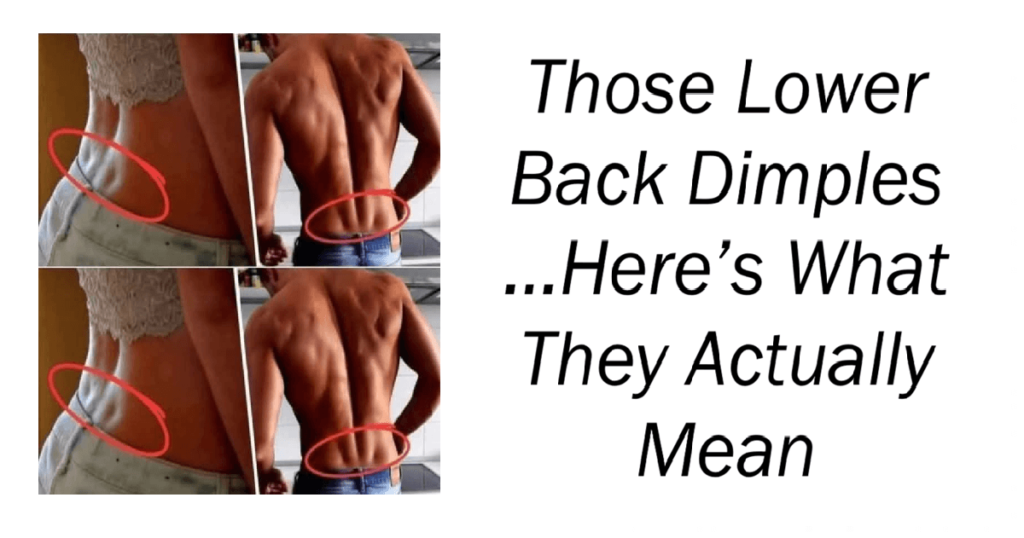
Those Lower-Back Dimples …Here’s What They Actually Mean
Those small indentations just above your buttocks are commonly called Venus dimples—and despite what viral posts suggest, they’re not a sign that you’re “special” in a medical or mystical sense.
They’re simply a normal anatomical variation.
What Causes Them?
Venus dimples form where the skin is anchored to a specific point on your pelvis called the posterior superior iliac spine.
A short ligament pulls the skin inward at that spot, creating the visible dip.
Whether you have them or not comes down to:
- Your bone structure
- How your ligaments attach
- Your genetics
That’s it—no hidden meaning beyond anatomy.
Are They Linked to Fitness or Health?
This is where things often get exaggerated.
It’s true that:
- They may be more visible in people with lower body fat
- A leaner physique can make them stand out
But:
- They are not a reliable indicator of health
- They don’t prove better circulation, strength, or fitness
- People in excellent shape may not have them at all
So while fitness can highlight them, it doesn’t create them.
Can You Get Them Through Exercise?
No.
You can’t “train” or “build” Venus dimples like a muscle.
However:
- If you already have the underlying structure
- And you reduce body fat
👉 They may become more noticeable.
What About Men?
Men can have them too—sometimes called “Apollo dimples”—but that’s just a cultural label, not a different biological feature.
Why People Attach Meaning to Them
Features like this often get linked to:
- Beauty standards
- Fitness culture
- Social media trends
But scientifically, they’re no different from:
- Dimples on cheeks
- Freckles
- Other inherited traits
Interesting—but not diagnostic.
The Bottom Line
- Venus dimples are genetic and anatomical
- They’re harmless and normal
- They don’t define your health, fitness, or uniqueness
Final Thought
It’s easy to assign meaning to small physical traits—but your health and strength come from what your body does, not how it looks in one specific spot.
You’ve just read Those Lower-Back Dimples . Why not read Can Mathematics Really Explain How We Think