
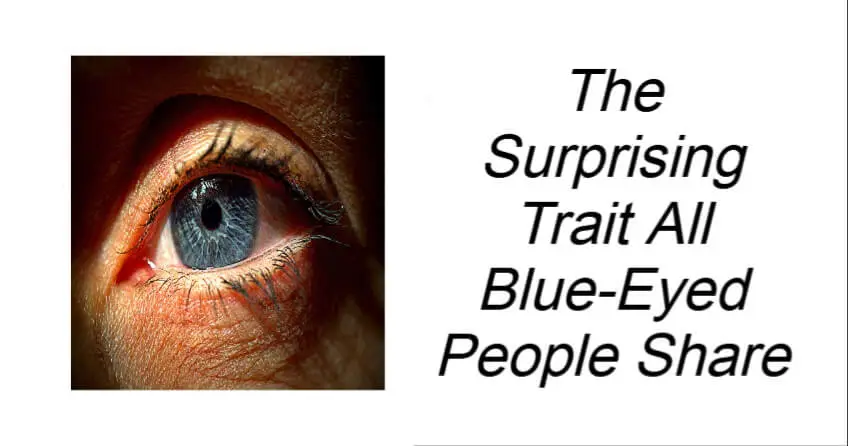
The Surprising Trait All Blue-Eyed People Share
Blue eyes have always carried a certain mystique. They’re the second most common eye color in the world, yet they still feel rare and striking. But what if that icy blue shade wasn’t just about appearance? What if it told a much deeper story—one that connects millions of people through a single moment in human history?
Let’s dive in.
Where Did Blue Eyes Come From?
Believe it or not, humans weren’t always walking around with blue or green eyes. Thousands of years ago, every single person on Earth had brown eyes—just in different shades. Then, somewhere between 6,000 and 10,000 years ago, something extraordinary happened.
A genetic mutation appeared.
This tiny shift in our DNA altered the way the body produced melanin—the pigment responsible for eye color. Instead of creating brown eyes, this mutation essentially “switched off” that function, giving rise to blue eyes for the very first time.
More Than Just a Pretty Color
Blue eyes might look stunning, but they come with their own quirks. One of the most noticeable? Sensitivity to light.
Because blue eyes contain less melanin, they offer less natural protection against bright light and UV rays. That’s why many blue-eyed people find themselves squinting on sunny days or reaching for sunglasses more often than others.
But it’s not all downside.
Some research suggests that people with blue eyes may excel in strategic thinking. While scientists haven’t fully explained why, it’s an intriguing pattern—especially when you consider famous blue-eyed thinkers like Stephen Hawking, Marie Curie, and Alexander Fleming.
Coincidence? Maybe. Or maybe there’s more to uncover.
The One Thing All Blue-Eyed People Have in Common
Here’s where the story gets truly fascinating.
Research led by Professor Hans Eiberg at the University of Copenhagen uncovered something remarkable: every single person with blue eyes today can trace their ancestry back to one individual.
Yes—one.
That original person carried the genetic mutation that created blue eyes, and over generations, it spread across populations, particularly as humans migrated from Africa into Europe.
In other words, if you have blue eyes, you are part of a vast, extended family tree that begins with a single ancestor who lived thousands of years ago.
A Window Into Human Evolution
What makes this discovery so powerful isn’t just the novelty—it’s what it reveals about us as a species.
Blue eyes aren’t just a physical trait. They’re evidence of how dynamic and ever-changing human genetics can be. A small mutation, in the right place at the right time, can ripple across centuries and shape millions of lives.
It’s a reminder that evolution isn’t just something that happened in the distant past—it’s an ongoing story, written into our DNA.
Final Thoughts
So the next time you notice someone with blue eyes—or catch your own reflection—you’re looking at more than just a color. You’re seeing a living connection to a single genetic event that changed human history.
It’s a beautiful thought, really.
Because in a world that often feels divided, something as simple as eye color reminds us of a deeper truth: we’re all more connected than we think.