
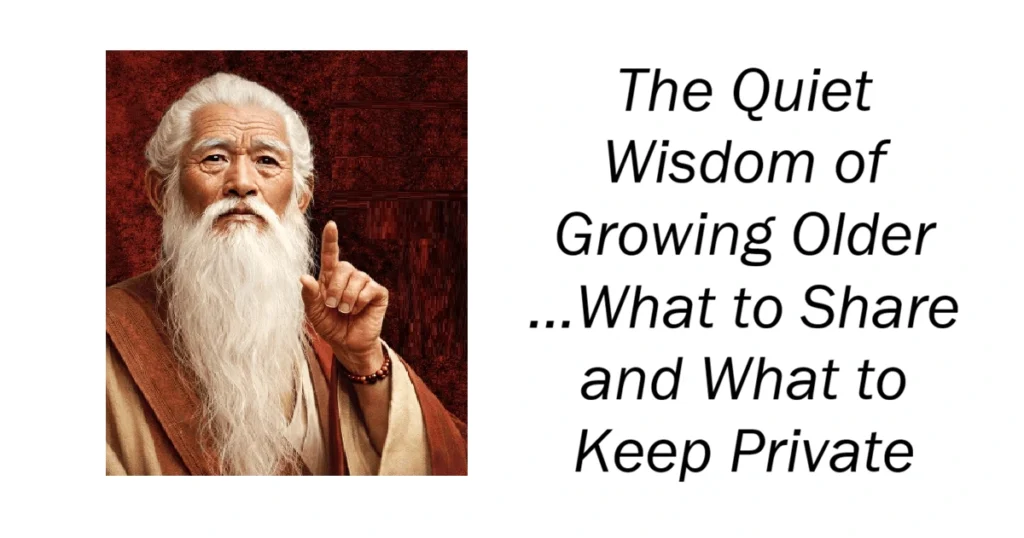
The Quiet Wisdom of Growing Older …What to Share and What to Keep Private
There comes a point in life when everything begins to shift.
The pace slows. Priorities change. And without fully realizing it, you start craving something deeper than achievement or approval—you want peace. Fewer explanations. Less noise. More clarity.
This is the space where Alejandro found himself.
Tired of the constant inner tension and unspoken conflicts of daily life, he set off on a journey to Tibet, hoping to find answers. Instead of grand revelations, he encountered something far more valuable: quiet, practical wisdom from a monk named Lobsang.
What emerged from their conversations wasn’t about secrecy or distance—but about discernment. Knowing what to share, what to hold close, and how to protect both your relationships and your sense of self.
Here are the seven principles that stayed with him.
1. Be Mindful About Sharing Health Concerns
It’s natural to talk about aches, test results, or discomforts. But sharing every detail can sometimes create unintended consequences.
Loved ones, especially children, may respond with worry that turns into control—checking in constantly, making decisions for you, or seeing you as more fragile than you feel.
Choosing discretion doesn’t mean hiding the truth. It means protecting your independence and avoiding unnecessary anxiety for everyone involved.
2. Keep Financial Matters Private
Money has a subtle way of changing relationships.
What feels like security and freedom to you might quietly become expectation or pressure for others. Even without bad intentions, knowing too much can shift dynamics in ways that are hard to undo.
Maintaining financial privacy helps ensure that your relationships remain grounded in care—not numbers.
3. Not Every Past Mistake Needs to Be Revisited
Sharing life lessons can be meaningful—but not every story needs to be told.
Some past mistakes, especially painful or complex ones, may not teach what you intend. Instead, they can alter how others see you in ways that don’t serve the relationship.
Some experiences have already fulfilled their purpose.
Not all wisdom needs an audience.
4. Protect Your Dreams
Whether it’s a long-awaited trip, a creative project, or a personal goal, sharing your dreams can sometimes expose them to doubt or discouragement.
Not everyone will understand what matters to you—and that’s okay.
Some dreams grow best in quiet spaces, where they’re nurtured rather than questioned.
5. Be Gentle With How You Share Your Fears
Fears about aging, illness, or dependency are deeply human. But expressing them constantly can unintentionally shift how others perceive you.
You may begin to be seen as fragile—even when you’re still strong and capable.
This doesn’t mean ignoring your fears. It means choosing the right space and people to process them, without placing that emotional weight on those closest to you.
6. Resist the Urge to Give Unsolicited Advice
Wanting to guide your children or loved ones is natural. But advice offered without being asked can feel like control rather than care.
True wisdom doesn’t insist—it waits.
Being present, supportive, and available often has a greater impact than stepping in too soon.
Sometimes, love looks like silence.
7. Protect Your Space—and What It Represents
Your home is more than a place. It’s your routine, your independence, your identity.
While moving in with family might seem like a practical or emotional step, it can come with hidden costs—loss of autonomy, disrupted habits, and a sense of disconnection from your own life.
Holding onto your space, when possible, is a way of honoring everything you’ve built.
A Few Gentle Reminders
As life evolves, so does the way we connect with others. A few simple principles can help maintain balance:
- Learn the difference between sharing and emotional unloading
- Protect your emotional independence as much as your physical one
- Surround yourself with people who listen without judgment
- Move at your own pace—there’s no rush
- Remember: love doesn’t always require explanation
Final Thoughts
There’s a quiet strength in knowing when to speak—and when to remain silent.
Keeping certain parts of your life private isn’t about distance or distrust. It’s about preserving your peace, your dignity, and the harmony of your relationships.
Because sometimes, the most powerful wisdom isn’t what we say—it’s what we choose to hold gently within ourselves.
You’ve just read The Quiet Wisdom of Growing Older . Why not read Say Goodbye to That Stubborn Yellow Ring