
My Husband Never Respected My Mother …Until a Shocking Family Truth Broke Him
My husband used to say poverty was a choice.
Not loudly or cruelly in public. His version of cruelty was quieter—polished enough to sound like wisdom.
“People stay poor because they make poor decisions,” he once said while scrolling through stock prices on his phone.
I stared into my coffee and pretended not to hear him.
Because my mother was poor.
And he knew it.
After my father died, she spent years cleaning offices, sewing clothes for neighbors, and skipping meals so I could finish college. At sixty-three, she still lived alone in a tiny apartment with peeling wallpaper and a heater that barely worked.
But she never complained.
Never begged.
Never asked anyone for help.
One evening, after seeing how empty her refrigerator was, I finally gathered the courage to speak.
“We should help Mom a little,” I said carefully while folding laundry. “Just until things get easier.”
My husband barely looked up from his laptop.
“She’s an adult.”
“I know, but—”
“She survived this long, didn’t she?”
His tone sharpened.
“Every dollar you give her comes out of our children’s future.”
The words hit harder than I expected.
Not because of the money.
Because of how easily he dismissed her entire life.
I wanted to argue. To remind him that my mother had worked herself sick raising me alone.
But over the years, I had learned something ugly about marriage:
The person who controls the money often controls the silence too.
The house was in his name.
The accounts were in his name.
So I nodded.
And said nothing.
A week later, we hosted a birthday dinner for him.
The house filled with loud laughter, expensive wine, and glossy gift bags from coworkers and relatives. Designer cufflinks. Golf resort tickets. Luxury whiskey.
My mother arrived last.
She stood quietly at the door wearing the same navy coat she’d owned for years. In her hands was a small wooden box.
My husband answered the door himself.
And I watched his face change instantly.
Confusion.
Shock.
Then something close to panic.
Because he recognized the box.
Slowly, my mother held it out to him.
“I think this belongs to you,” she said softly.
His hands trembled as he opened it.
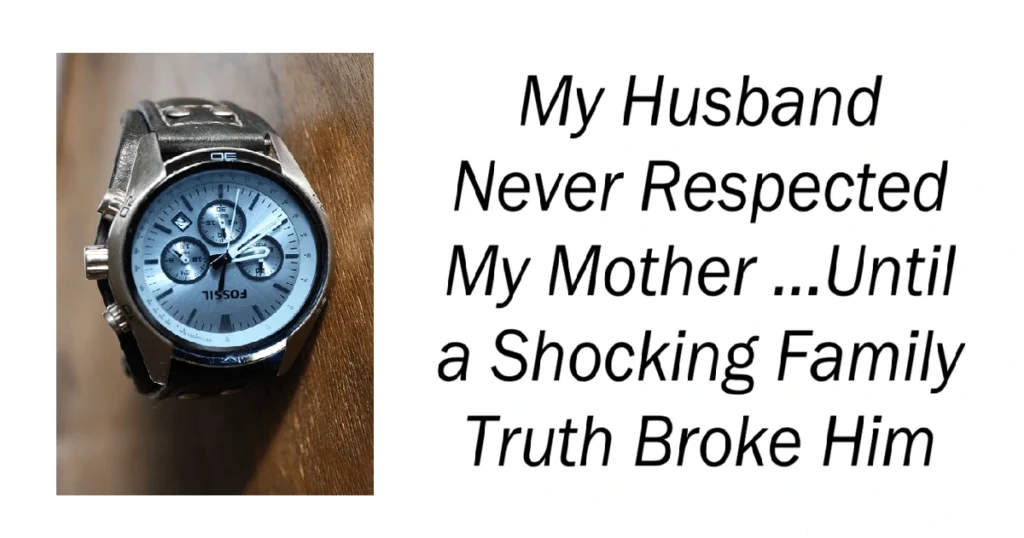
Inside was his father’s watch.
A rare vintage watch—the family heirloom everyone believed had disappeared after his father died.
The room fell silent.
“You…” His voice cracked. “Where did you get this?”
My mother smiled gently.
“Your father gave it to me many years ago.”
My husband stared at her as though seeing her for the first time.
Later that night, after the guests left, we sat quietly in the kitchen while rain tapped against the windows.
And my mother finally explained.
After my father died, my father-in-law learned she was secretly working three jobs to keep me in school.
Without telling anyone, he visited her.
He brought groceries.
Cash.
And the watch.
“He told me to sell it if things ever became unbearable,” she said softly. “He said pride doesn’t feed people.”
My husband sat frozen.
“I didn’t want to take it,” she continued. “But he insisted.”
“Then why didn’t you sell it?” he whispered.
She looked down at her hands.
“Because it mattered to him.”
Then she smiled faintly.
“And because I hoped one day it would matter to you.”
My eyes burned with tears.
All those years.
All those winters in old coats.
All those skipped meals.
She could have sold that watch at any moment. Paid her debts. Fixed her apartment. Lived comfortably for years.
But she protected it instead.
Not out of obligation.
Out of gratitude.
Someone had once shown her kindness when she needed it most, and she chose to honor it.
My husband looked devastated.
Not dramatic.
Not defensive.
Just ashamed.
For the first time since I’d known him, he had no argument left.
No speeches about responsibility.
No financial logic.
Only silence.
That night, after my mother left, he sat alone in the living room holding the watch for nearly an hour.
Finally, he said quietly:
“I was wrong.”
Three simple words.
But men like my husband rarely said them.
Things didn’t change overnight.
He didn’t suddenly become sentimental or soft.
But slowly, he changed.
He repaired my mother’s heater before winter arrived.
Then quietly started paying for her groceries.
When her kitchen sink broke, he drove over himself instead of hiring someone.
And the biggest change wasn’t what he did.
It was how he spoke to her.
The cold politeness disappeared.
He started listening.
Really listening.
Sometimes I’d walk into the kitchen and find them drinking tea together while she told stories about my childhood.
And once, when he thought I couldn’t hear him, I caught him saying softly:
“You raised an incredible daughter.”
My mother smiled the way lonely people smile when they finally feel seen.
She never defended herself.
Never demanded respect.
Never tried to shame him for the way he treated her.
She simply answered judgment with grace.
And somehow, that changed everything.
You’ve just read My Husband Never Respected My Mother. Why not read Are Wireless Earbuds Dangerous