
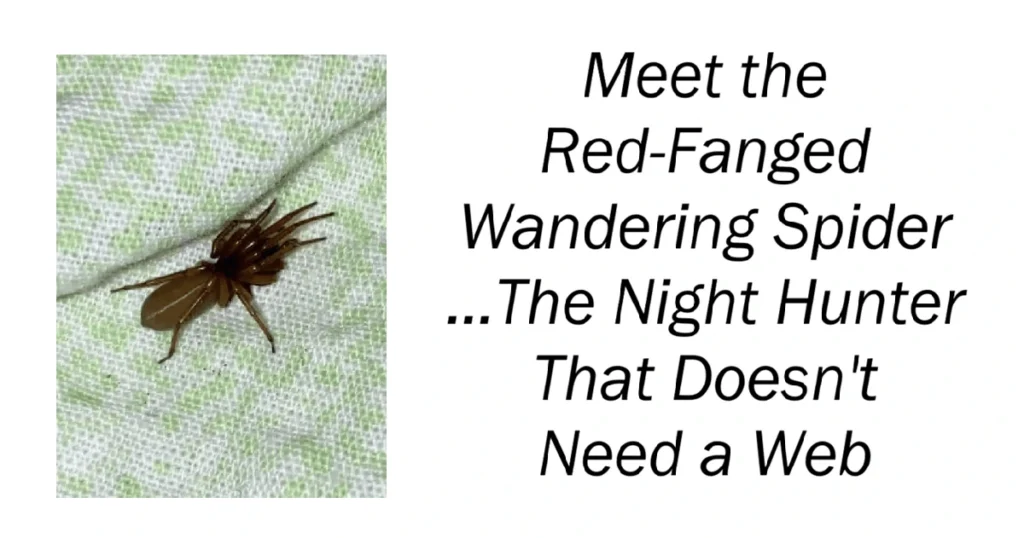
Meet the Red-Fanged Wandering Spider …The Night Hunter That Doesn’t Need a Web
When most people picture a spider, they imagine a creature sitting patiently in the center of an intricate web, waiting for an unlucky insect to wander into its trap.
But not every spider hunts that way.
The red-fanged wandering spider has taken a very different approach. Instead of relying on sticky silk to catch prey, this remarkable nocturnal hunter actively searches for its next meal. It depends on speed, stealth and highly sensitive senses to track down insects and other small creatures under the cover of darkness.
And, as its name suggests, its most striking feature may be its vivid reddish fangs.
A Spider That Hunts on the Move
As night falls, the wandering spider emerges from its daytime hiding place.
Rather than waiting for prey to come to it, the spider actively explores its surroundings, moving across the ground in search of potential meals.
It may shelter beneath rocks, fallen logs, leaves or other protected areas during the day. Once darkness arrives, it begins its nighttime hunt.
This active lifestyle sets it apart from many familiar web-building spiders.
There is no elaborate trap waiting for an insect.
The spider is the trap.
How Does It Find Its Prey?
For a small predator moving through darkness, detecting prey can be challenging.
The spider’s body is equipped with highly sensitive structures that help it detect vibrations and movements in its surroundings. Tiny disturbances produced by nearby insects can provide important clues about where potential prey is hiding.
Instead of relying primarily on vision, the spider can use these sensory signals to locate movement with remarkable precision.
Once it gets close enough, the quiet search can suddenly turn into a lightning-fast attack.
Those Red Fangs Have a Purpose
The spider’s reddish fangs aren’t simply an unusual feature that makes it look intimidating.
Like other predatory spiders, it uses its fangs to inject venom into prey. The venom helps subdue the animal, allowing the spider to feed without having to wrestle with struggling prey for an extended period.
For a small insect, the encounter can be over in seconds.
What looks like a dramatic battle is actually an extremely efficient hunting strategy—detect, approach, strike and feed.
A Predator That Helps Control Insects
Although spiders can make some people nervous, their role in ecosystems is often beneficial.
Predatory spiders consume large numbers of insects and other small invertebrates. By hunting these creatures, they become part of the natural system that helps regulate populations within their habitat.
The red-fanged wandering spider is no exception.
Its nighttime hunting behavior allows it to target prey that may be active after dark, adding another layer to the ecosystem’s natural predator-prey balance.
Should Humans Be Afraid of It?
Its powerful appearance and prominent fangs might make this spider look frightening.
But appearance alone doesn’t determine how dangerous an animal is to people.
This type of spider generally has little reason to confront humans and would typically prefer to avoid a much larger animal. Like many wild creatures, it is far more interested in finding food and shelter than interacting with people.
As with any unfamiliar spider, however, it’s sensible not to handle it unnecessarily.
Why Doesn’t It Need a Web?
Web-building is one of the most recognizable spider strategies, but it is only one solution to the challenge of finding food.
Different spiders have evolved remarkably different hunting techniques.
Some construct elaborate webs.
Others ambush prey from hiding places.
Some actively chase their targets.
The red-fanged wandering spider belongs to this last group, demonstrating how successful a spider can be without relying on a traditional prey-catching web.
Its body, sensory abilities and hunting behavior have evolved together to support an entirely different lifestyle.
The Nighttime Hunter With an Unusual Strategy
There is something fascinating about a predator that becomes most active when the world around it grows quiet and dark.
While many people are asleep, the red-fanged wandering spider may be moving across the ground, sensing vibrations and searching for its next meal.
It doesn’t need a giant web stretching between branches.
It doesn’t need to sit motionless and wait.
Instead, it takes the hunt directly to its prey.
That combination of stealth, speed and sensory ability makes it a fascinating example of evolutionary adaptation.
The Bigger Lesson From This Unusual Spider
The natural world is full of creatures that don’t fit the familiar picture we have in our heads.
Not every spider builds a web.
Not every predator relies on size or brute strength.
And not every creature with intimidating features is a threat to humans.
The red-fanged wandering spider shows just how many different strategies can evolve to solve the same basic problem: finding food and surviving.
When darkness falls, this tiny hunter leaves its hiding place and begins its search.
No web.
No waiting.
Just sensitive instincts, remarkable speed and a pair of striking red fangs.
You’ve just read Meet the Red-Fanged Wandering Spider. Why not read Why Do Muscle Cramps Happen So Suddenly