
Man Refuses $220K to Relocate House Stands Isolated by Highway
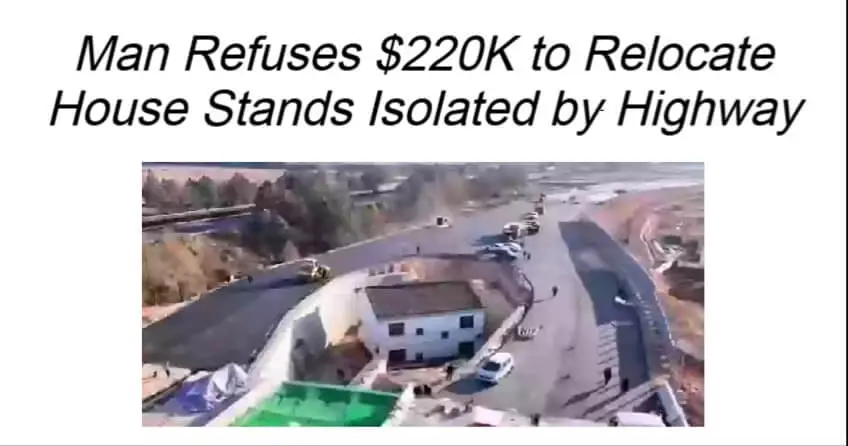
In a striking example of China’s so-called “nail houses”—a term used for properties whose owners refuse to vacate despite demolition orders—Huang Ping’s two-story home in Jinxi County now stands isolated, surrounded on all sides by a newly constructed motorway.
Despite being offered a compensation package worth £180,000 and two alternative housing options by local authorities, Huang declined the deal, citing dissatisfaction with the terms. As construction advanced around his property, Huang and his 11-year-old grandson were left living in the middle of a highway, enduring constant dust, deafening noise, and ground-shaking vibrations.
Now, with the motorway nearly complete, Huang reflects on his decision with regret: “If I could turn back time, I would agree to the demolition conditions they offered,” he admitted. “Now it feels like I lost a big bet.”
The “nail house” phenomenon is not uncommon in China, where the speed of urban expansion often clashes with the personal ties residents have to their homes. In some cases, developers and local governments, determined to push forward, simply build around the holdouts—leaving bizarre, surreal scenes of lone homes amid busy infrastructure.
Huang’s defiant stand has drawn local attention, with curious passersby stopping to see the house marooned in the middle of a motorway—an unintended monument to personal resistance and the human cost of rapid modernization.
With the highway set to open soon, Huang now faces an uncertain future. His once-peaceful home is caught in a whirlwind of traffic and change—an ironic end to a battle meant to preserve it.
You’ve just read, Man Refuses $220K to Relocate. Why not read Manager Had To Hire A New Employee.