
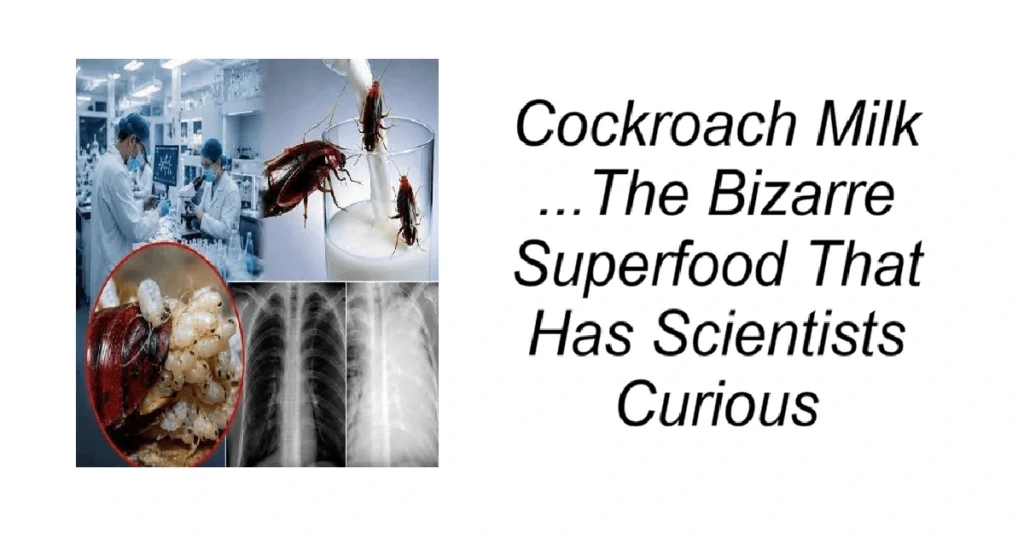
Cockroach Milk …The Bizarre Superfood That Has Scientists Curious
When you hear the words cockroach milk, your first reaction probably isn’t to reach for a glass. But this unusual substance has attracted scientific interest for a surprising reason: it could offer clues to creating highly concentrated, nutrient-rich foods in the future.
Believe it or not, scientists have been studying a rare cockroach species that produces a milk-like substance to nourish its developing young. And what’s inside this unusual secretion is even more fascinating than its name.
What Exactly Is Cockroach Milk?
The substance comes from Diploptera punctata, commonly known as the Pacific beetle cockroach. Unlike most cockroach species, this insect gives birth to live young and provides nourishment to its developing embryos through a specialised secretion.
Rather than producing milk in the same way as cows or humans, the cockroach supplies nutrients that form tiny protein crystals inside the embryos. These crystals act as a concentrated source of nourishment, helping the developing young grow.
Researchers have found that the crystals contain proteins, carbohydrates, and fats, along with essential amino acids. This combination makes them particularly interesting to scientists investigating how nature stores and delivers energy efficiently.
Why Are Scientists So Fascinated by It?
The biggest surprise is the extraordinary energy density of these microscopic crystals.
A 2016 structural study examined the composition of cockroach-milk protein crystals and estimated that they contain more than three times the energy per equivalent mass of dairy milk.
That discovery helped fuel headlines describing cockroach milk as a potential superfood. However, claims that it is simply four times more nutritious than cow’s milk are misleading. Energy density is only one measure of nutrition, and it doesn’t automatically mean a food is healthier or better for humans.
What makes these crystals remarkable is the way they package nutrients into a compact form. Understanding this natural process could help researchers explore new approaches to food science, nutrition, and biotechnology.
Could Cockroach Milk Become the Next Superfood?
It’s an intriguing possibility, but don’t expect to find cartons of cockroach milk lining supermarket shelves anytime soon.
Harvesting the secretion directly from cockroaches would be extremely difficult to scale up. The substance is produced in small quantities, and collecting enough of it for commercial food production would present considerable practical challenges.
There are also important questions that scientists would need to answer before considering it for human consumption. These include its safety, digestibility, production methods, processing requirements, and suitability as part of a balanced diet.
In other words, an interesting discovery in the laboratory is not the same thing as a proven superfood.
Could Biotechnology Hold the Key?
Rather than harvesting the substance directly from insects, researchers may find more practical ways to reproduce its useful properties.
Biotechnology could potentially help scientists investigate how these protein crystals form and whether similar nutrient-rich structures could be produced using alternative methods.
Such research might eventually contribute to new approaches to food production, particularly as scientists look for efficient ways to deliver nutrients in compact, stable forms.
However, these possibilities remain areas of scientific interest rather than established commercial applications.
The Bottom Line: A Strange Discovery With Fascinating Potential
Cockroach milk might sound like something from a science-fiction film, but the science behind it is real. The Pacific beetle cockroach produces a nutrient-rich secretion that forms unusual protein crystals, giving researchers a fascinating example of how nature packages energy and nutrients.
Although claims about its status as a miracle superfood should be treated cautiously, the discovery raises intriguing questions about future food technology.
The most exciting possibility may not be drinking milk from cockroaches at all. Instead, scientists could learn from these remarkable crystals to develop new ways of producing and delivering nutrients.
Sometimes, the most unexpected discoveries in nature can inspire the most interesting scientific questions.
You’ve just read Cockroach Milk. Why not read My Nana’s Simple Trick for Thick Toenails