
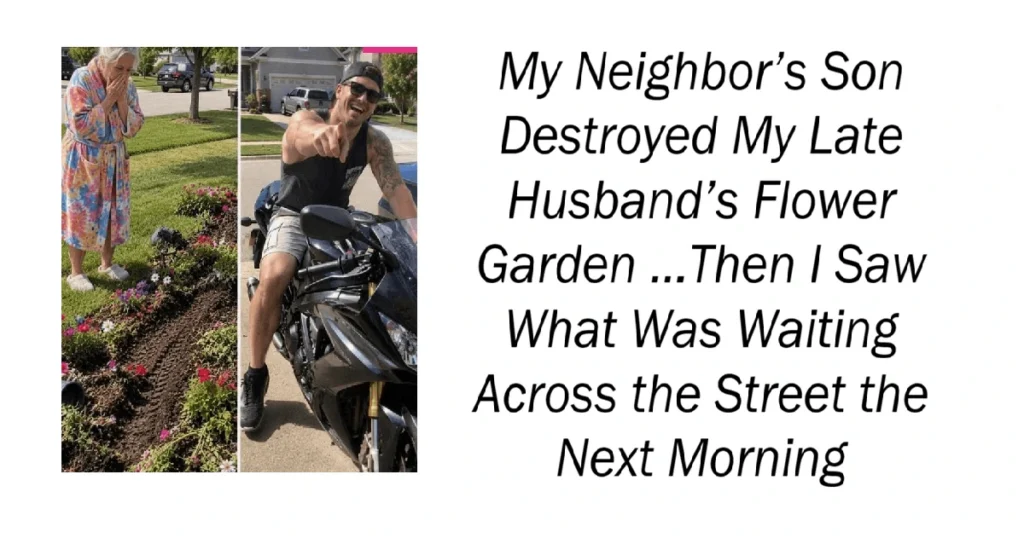
My Neighbor’s Son Destroyed My Late Husband’s Flower Garden …Then I Saw What Was Waiting Across the Street the Next Morning
I watched something precious to me get crushed into the dirt, only to be told it was no big deal. I went inside furious, never imagining what I’d discover across the street the following morning.
The motorcycle roared past my kitchen window, rattling the glass. I gripped the edge of the sink, my hands still damp from washing my coffee cup. I didn’t even need to look outside to know who was responsible for the noise.
Still, I peeked through the curtain.
There was Tyler, swinging around the corner on his shiny red motorcycle, his helmet dangling from the handlebars as though traffic laws were merely suggestions.
“Lord have mercy,” I muttered. “That boy’s going to break his neck, and half the neighborhood will send flowers just to be sure.”
I’d lived in this house for nearly thirty years. My husband, Abraham, had carried me across the threshold when my hair was still brown and my knees didn’t complain every time I climbed the stairs.
That first summer, he spent nearly every weekend on his hands and knees in the front yard, digging up sod and hauling bags of soil. By the time he finished, he’d created a flower garden beside the walkway, just for me.
He planted red and yellow flowers because those were the colors he brought me every anniversary, wrapped in brown paper from our local florist.
“So you never forget what day it is,” he used to tease.
“You’re the one who forgets, Abraham. I just play along.”
He passed away eleven years ago this March, but I’d kept his garden alive. Every spring, I planted fresh red and yellow blooms in the same bed, tending them as carefully as if they were a living piece of him.
They weren’t expensive flowers, but their value had never been about money.
Every morning, I filled my watering can and cared for them. Some days, I even talked to them.
Across the street, my neighbor Denise would usually be on her porch, sweeping the same three boards she’d swept the day before.
She was in her early sixties, full of energy, and always ready with a joke.
“Morning, Ember!” she’d call. “Your garden’s looking loud today!”
“Loud is the point, Denise!”
“Abraham would be proud!”
“Abraham would say I’m overwatering!”
We’d laugh, and that was how most mornings had gone for years. Denise was the sort of neighbor a widow could be grateful for: warm, familiar, and always nearby.
Then summer arrived, and Tyler came home from college.
At twenty-two, he seemed to believe the world existed for his convenience. His father, Gerald, owned half the storefronts in town, and Tyler wore that privilege as casually as his expensive clothes.
For months, he’d revved his motorcycle late at night, parked across driveways, and cut corners over people’s lawns as though the entire neighborhood belonged to him.
By autumn, everyone was fed up.
My next-door neighbor, Mr. Petersen, had approached Tyler three times to ask him to stop. Each time, Tyler smiled, nodded, and carried on as before.
“Somebody ought to say something to Gerald,” Mr. Petersen told me one afternoon over the fence.
“Somebody ought to,” I agreed. “But half the people on this street rent from that man, and the other half owe him a favor.”
Mr. Petersen sighed. We both knew how things worked around here.
Still, I couldn’t shake the feeling that Tyler would eventually go too far.
“One of these days,” I said to my empty kitchen that Saturday afternoon, “that boy is going to pick the wrong yard.”
I had no idea how soon I’d be proven right.
The motorcycle turned at the end of the street and came roaring back toward my house. I turned away from the window for a moment, and by the time I looked again, Tyler was cutting across my front lawn.
His back tire tore straight through Abraham’s flower bed.
I heard the crunch before I fully understood what had happened: the awful, soft sound of stems snapping beneath the weight of the motorcycle.
I stood frozen for a moment.
Then I walked outside in my house slippers, gripping the porch rail as I made my way down the steps. At seventy-one, I had no intention of running across the yard and giving Tyler the dramatic confrontation he might have enjoyed.
Half my red and yellow flowers lay flattened in the mud. A deep tire track cut through the middle of the bed, as though someone had drawn a line straight through a love letter.
Tyler was still sitting astride his motorcycle, his helmet pushed back and a grin on his face.
“Young man,” I said, trying to keep my voice steady, “those flowers were planted for my husband. He passed away eleven years ago.”
Tyler glanced at the wreckage, then back at me.
He shrugged.
“It’s just grass and flowers. They’ll grow back.”
“They won’t be the same,” I replied. “Not the way he planted them.”
“They’re plants.” He smirked. “Relax. I didn’t do it on purpose.”
“You didn’t do it by accident, either.”
Across the street, I caught sight of Denise standing on her porch. Our eyes met, and for one hopeful moment, I thought she would come over. At least someone had witnessed what happened.
Instead, she stepped inside and shut the door.
That hurt almost as much as seeing the garden destroyed. Denise had brought me soup when I was sick with bronchitis and waved to me nearly every morning. I couldn’t understand why she’d suddenly chosen to pretend she hadn’t seen anything.
Tyler noticed her retreat, too, and his grin widened.
“See? Nobody’s dying over some marigolds.”
“They weren’t marigolds.”
“Whatever.” He kicked the motorcycle into life. “Have a nice day.”
Then he rode away, slowly enough to make sure I watched him go.
I remained beside the ruined garden for a long time. Eventually, I bent down and picked up one broken yellow blossom. Its stem had been crushed flat, but I slipped it into my apron pocket anyway.
Then I went inside, closed the door quietly, and sat at the kitchen table.
Abraham’s photograph was still on the refrigerator, exactly where it had been for more than a decade. In it, he was squinting into the sunshine, dirt on his knees, holding up a trowel as proudly as if he’d won a trophy.
I looked at his picture.
“I know what you’d say,” I told him. “You’d tell me he’s just a kid and that I should let it go.”
But this time, I wasn’t ready to.
I picked up my phone and dialed a number I’d known by heart for years.
The person on the other end answered on the second ring.
“It’s Ember,” I said. “I need to ask you something, and I need you to be honest about whether you can help.”
There was a brief silence.
Then the voice softened.
I explained what had happened and listened carefully to the response. Before we hung up, I’d said thank you twice.
When I put down the phone, my hands had stopped shaking.
I looked at Abraham’s photograph again.
“I’m sorry, love,” I whispered. “I know what you’d want me to do. But not this time.”
I placed the broken yellow flower in a little jelly jar of water on the windowsill. It wouldn’t recover, and I knew that. Still, throwing it away felt wrong.
Then I made myself a cup of tea and sat beside the window overlooking the street.
I had no idea what the next morning would bring. I only knew that something was about to change.
And I intended to be there when it did.
Sunday morning arrived slowly, bathing the street in golden light. I stood at my kitchen window with a cup of coffee I barely touched, pretending I wasn’t waiting for anything.
At 9:30, Tyler came out of his house with his helmet tucked under one arm. He was whistling, looking as carefree as ever.
Then he stopped.
He stood in the middle of his driveway, staring at something beside his motorcycle. Within seconds, the smug expression disappeared from his face.
A large ceramic pot stood beside the bike, overflowing with red and yellow flowers—the very colors of my ruined garden. A printed sheet of paper was taped to his handlebars, flapping in the morning breeze.
And leaning against the garage, arms folded across his chest, stood Gerald.
Tyler looked at the flowers, then at the paper, and finally at his father. His expression suggested that he couldn’t quite believe what he was seeing.
Then he looked across the street, straight toward my window.
I raised two fingers in a small wave before setting down my coffee and heading for the front door.
By the time I stepped outside, Gerald had turned to his son.
“Read it out loud, Tyler.”
“Dad, come on.”
“Read it.”
Tyler glanced around, clearly hoping the ground might open up and swallow him.
Finally, he began.
“I, Tyler, will work with a landscaper to completely restore my neighbor’s flower garden. Every plant will be replaced by my own hands, under Mrs. Halloran’s supervision.”
Gerald folded his arms more tightly.
“And don’t you dare think calling her ‘ma’am’ makes up for what you did!”
Tyler stared at him.
“Seriously, Dad?”
“Your keys. Now.”
For a moment, Tyler looked as though he might argue. Then he reluctantly dropped the motorcycle keys into his father’s outstretched palm.
I couldn’t help smiling. Abraham would probably have called it an unchristian expression, but I suspected he’d have enjoyed the sight all the same.
I took a sip of my coffee. It had gone cold.
For once, I didn’t care.
That afternoon, the doorbell rang.
Tyler stood on my porch wearing a pair of brand-new gardening gloves, with the store tag still dangling from one wrist. He held a tray of red and yellow starter plants as cautiously as though they might bite him.
“My dad said…” He stopped, cleared his throat, and tried again. “Mrs. Halloran, I’m here to help restore your flower bed with a landscaper.”
“How nice,” I replied, opening the door wider.
The landscaper stood behind him, looking far more comfortable with the situation than Tyler did.
I led them to the garden and pointed toward the muddy scar running through the flower bed.
“I certainly appreciate the effort,” I said. “Now, let’s make sure we do it properly.”
I handed Tyler a trowel.
He examined it as though he’d never seen one before.
“You dig where I point,” I explained. “Place the roots gently, then pat the soil down. Don’t pack it too tightly. Flowers aren’t concrete.”
Tyler glanced at the landscaper, perhaps hoping for a reprieve.
“You heard her,” the man said. “Best do as you’re told.”
“Yes, Mrs. Halloran,” Tyler muttered.
“Ember.”
He looked up.
“My name is Ember. You can call me that.”
“Yes, Ember.”
He knelt in the dirt, his expensive jeans gathering mud at the knees, and began digging. The landscaper showed him how to prepare the soil and position each plant, while I settled onto the porch step with a fresh cup of coffee.
For a while, nobody spoke.
Tyler concentrated on the work, his earlier confidence replaced by the awkward seriousness of someone who had finally realized that an apology meant more than saying the right words.
After he finished the second row, I decided to tell him what he’d actually destroyed.
“His name was Abraham,” I said.
Tyler paused, the trowel resting in his hand.
“My husband. When we first moved here, he spent an entire summer building this garden for me. He chose red and yellow because those colors meant something special to us.”
“Oh,” Tyler said quietly.
“Every anniversary, he’d bring me flowers in those colors. He kept doing it for years, right up until he passed away.”
Tyler looked down at the plants.
“I didn’t know that.”
“No,” I replied gently. “You didn’t. Because you never cared enough to ask.”
He returned to work without another word.
As he dug the next row, I noticed that the smirk I’d seen on his face so many times that summer had finally disappeared.
For the first time since he’d come home from college, Tyler seemed willing to listen rather than assume he already knew everything.
Still, something puzzled me.
I’d made only one phone call the previous afternoon. It hadn’t been to Gerald, the police, or a lawyer. I’d called my sister, who worked as a contractor, hoping she could help me figure out how to restore the garden.
She’d promised to look into it, but later sent me a message saying something urgent had come up and she’d have to visit the following day.
So how had Gerald learned about the incident before sunrise?
I was still turning the question over in my mind when the screen door across the street creaked open.
Denise emerged carrying a tray with a pitcher of lemonade and three glasses. She walked toward us as though this were an ordinary Sunday visit.
“Thought you might all be thirsty.”
“Bless you,” I said, accepting a glass.
A moment later, Gerald crossed the street, his hands tucked into his pockets. When he reached Denise, he gave her a look so soft and affectionate that I nearly forgot about the flowers.
“You’re adorable,” he told her.
Denise turned the same shade of red as the blooms in my garden.
I slowly tilted my head.
Well, now. That was interesting.
Later that evening, Denise invited me to sit with her on the porch and finish the lemonade.
I had a question that had been bothering me all day, and I decided it was time to ask.
“Denise, did you have something to do with Gerald finding out about my garden before sunrise? I called my sister yesterday, but she couldn’t come until today.”
Denise let out a sheepish laugh and swirled the lemonade in her glass.
“Yes,” she admitted. “I told him last night.”
I stared at her.
“When Tyler went out with his friends, I went straight over to Gerald’s house and explained what had happened.”
“But why didn’t you come over when it happened? I thought you were just going to leave me standing there.”
Denise’s smile faded.
“I know. And I’m sorry. I should have explained, but I couldn’t do it in front of Tyler.”
She took a breath before continuing.
“Ember, Gerald and I have been seeing each other for almost a year.”
I nearly dropped my glass.
“You and Gerald?”
She nodded, looking embarrassed but happy.
“He lost his wife a few years ago, and he wasn’t ready for everyone to know he was dating again. I didn’t want the whole neighborhood gossiping about us, so we kept things quiet.”
I leaned back, trying to take it all in.
“That explains why you went inside. But why couldn’t you say something to Tyler?”
“Because I needed Gerald to handle his own son. I couldn’t storm across the street and start scolding Tyler without putting Gerald in an impossible position. I wanted him to hear what had happened from me privately, then decide how to deal with it as a father.”
I considered that for a moment.
“And the flowers in his driveway?”
Denise grinned.
“My idea. I told Gerald that if Tyler thought your garden was just a collection of plants, he needed to understand that replacing it was his responsibility. I suggested the pot as a reminder of what he’d destroyed, and Gerald decided to make him write out his promise.”
I shook my head, half laughing and half amazed.
“Denise, you absolute menace!”
“In the best possible way, I hope.”
“In the very best way.”
We laughed until the tension of the previous day finally seemed to lift.
Then I reached over and squeezed her hand.
“I thought you’d abandoned me.”
“I know,” she said softly. “And I’m sorry I made you feel that way. I should have found a way to reassure you.”
“I forgive you. But next time, perhaps a little warning would be nice.”
She laughed again, and I joined her.
For the first time, I understood that her silence hadn’t meant indifference. She’d been trying to find a way to help without making an already difficult situation worse.
And in the end, she’d done far more than I could have expected.
Over the following weeks, Tyler finished restoring the flower bed under the landscaper’s supervision. He learned how to prepare the soil, plant the flowers, and care for them properly.
He also learned Abraham’s name, and I told him a few stories about the man who had built the garden all those years ago.
The late-night motorcycle revving stopped, too. Tyler began wearing his helmet properly, and the neighbors gradually stopped bracing themselves every time they heard an engine.
Meanwhile, Gerald and Denise no longer bothered hiding their relationship. Before long, they were walking down the street together, hand in hand, looking happier than I’d seen either of them in years.
One evening, as the sun began to set, I stood beside Abraham’s garden and admired the fresh red and yellow blooms swaying in the breeze.
The new flowers weren’t exactly the same as the ones he’d planted. They couldn’t be. But the garden was alive again, and with every passing day, it looked a little more like home.
I knelt to straighten one of the stems, brushing a little soil from its leaves.
“The flowers are fine, love,” I whispered toward the photograph waiting for me inside. “And it turns out I had better neighbors than I realized.”
For the first time since Tyler’s motorcycle had torn through the garden, I felt at peace.
I’d thought the worst part of that afternoon was watching something precious get destroyed. But the days that followed reminded me that a garden was never just a collection of flowers. It held memories, love, and the care someone had put into making something beautiful.
And sometimes, the people you think have let you down are simply waiting for the right moment to stand beside you.
That morning, I had expected to find a ruined garden and a boy who had learned nothing.
Instead, I found the beginning of something better: a garden restored, a friendship strengthened, and a reminder that even the most inconsiderate people can learn to see beyond themselves.
Abraham had planted those flowers for me nearly thirty years ago.
Thanks to a little accountability, an unexpected romance, and a neighbor who cared more than I’d realized, they would keep telling our story for years to come.
You’ve just read My Neighbor’s Son Destroyed My Late Husband’s Flower Garden. Why not read Foods You Should Be Careful When Reheating