
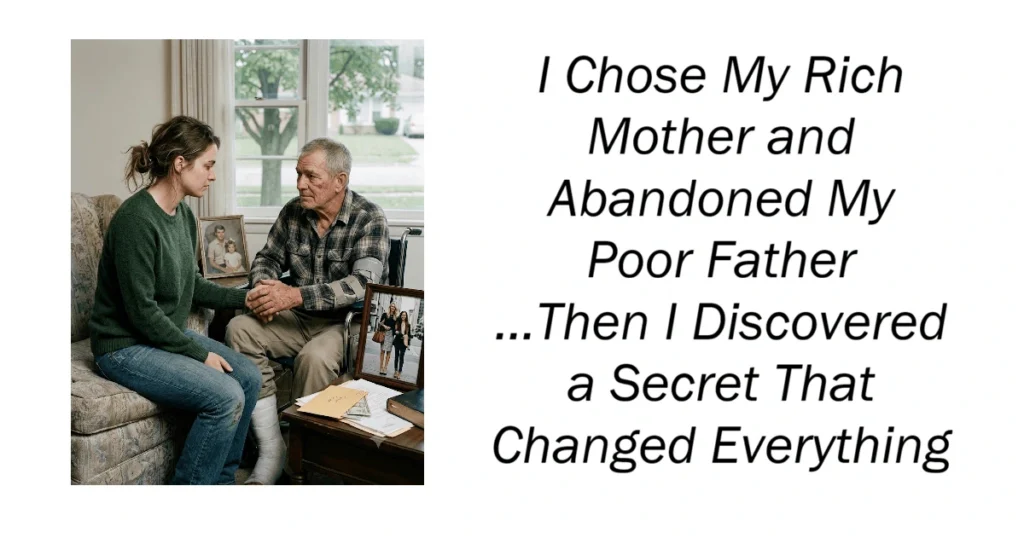
I Chose My Rich Mother and Abandoned My Poor Father …Then I Discovered a Secret That Changed Everything
I was five years old when my mother packed a single suitcase and walked out of our house.
I still remember that morning.
I stood by the window, my fingers pressed against the glass, watching her walk toward the car. I kept waiting for her to stop, turn around, and come back for me.
She never did.
The car disappeared at the end of the street, and for many years, that was the last time I saw my mother.
From that day on, it was just my father and me.
Dad worked four jobs to keep us going.
Four.
He left before sunrise and often didn’t come home until long after dark. When he finally walked through the door, his clothes smelled of grease, sweat, and cheap coffee. His hands were rough from years of hard labor, and dark circles had settled beneath his eyes.
He was exhausted.
But he never complained.
Even with four jobs, we were still poor.
Our refrigerator was often half empty. Sometimes Dad would tell me he wasn’t hungry so I could have the last portion of food.
My clothes came from thrift stores. My shoes were usually hand-me-downs. At school, I watched other children show off new toys, expensive sneakers, and birthday gifts I could only dream about.
When I was young, I understood that Dad was doing everything he could.
But as I grew older, understanding slowly turned into resentment.
By the time I became a teenager, that resentment had hardened into anger.
I blamed him for everything.
One night, after seeing another classmate arrive at school in a brand-new car, I finally exploded.
“You’re a loser,” I told him.
Dad was sitting at the kitchen table, counting the money he’d earned that week.
I kept going.
“You work four jobs and we’re still poor. Maybe you’re just not good enough.”
The words came out crueler than I intended.
I wanted him to fight back.
I wanted him to yell at me, punish me, or tell me I was wrong.
Instead, he simply looked at me.
Then he smiled.
It wasn’t a happy smile.
It was the tired, patient smile of a father who knew his child was hurting.
He said nothing.
At the time, his silence made me even angrier. I thought it meant weakness.
I didn’t understand that sometimes staying quiet takes more strength than fighting back.
Then, when I was seventeen, my mother came back.
Everything about her seemed different.
She arrived in a shiny car, wearing expensive jewelry and perfume that filled the room. She had married a wealthy man and was living in a huge house.
She talked about her “new life” as though the years she’d spent away from me were nothing more than an unpleasant chapter she’d decided to close.
And I was fascinated.
I wanted that life.
I wanted beautiful clothes, a big house, nice cars, and the kind of comfort I’d never had with Dad.
Then my mother offered to take me home with her.
I didn’t hesitate.
I packed my belongings and left.
Dad stood in the doorway of the same little house he’d practically destroyed himself trying to keep.
I expected him to stop me.
He didn’t.
He didn’t beg.
He didn’t cry.
He simply hugged me and said,
“If this is what you want, go.”
I walked away without looking back.
After that, Dad never called.
At first, I told myself he was angry.
Then I convinced myself he was too proud to reach out.
So I didn’t call either.
For ten weeks, I lived with my mother and her wealthy husband.
The house was beautiful.
My room was larger than the entire living room I’d shared with Dad.
I had expensive clothes, good food, and everything I’d once believed would make me happy.
But something felt wrong.
My mother was physically there, yet she never seemed interested in the ordinary parts of my life.
She didn’t ask whether I was happy.
She didn’t ask whether I missed Dad.
And whenever I mentioned him, she changed the subject.
Then, one weekend, I returned to my hometown to visit some old friends.
On an impulse, I decided to stop by the house where Dad and I had lived.
The moment I opened the front door, my blood ran cold.
The house was almost empty.
The couch was gone.
The television was gone.
The photographs that had once covered the walls were gone.
It looked less like a home and more like an abandoned shell.
I stood there in confusion until a neighbor saw me.
Her expression changed immediately.
“Oh, honey…”
Something was wrong.
She told me my father had been in a terrible car accident.
He had suffered severe injuries and needed multiple surgeries.
He had sold nearly everything he owned to pay the hospital bills and keep himself alive.
I couldn’t breathe.
I ran to the hospital.
When I finally saw him, I almost collapsed.
He looked nothing like the father I remembered.
His face was pale and thinner. Tubes surrounded him, and machines beeped beside his bed.
The man who had once worked four jobs to keep me fed now looked so fragile that I was terrified to touch him.
I fell beside his bed and began sobbing.
“Dad, I’m sorry.”
He slowly opened his eyes.
“I’m sorry I left.”
His fingers moved weakly toward mine.
“I’m sorry I chose Mom.”
My voice broke.
“And I’m sorry I called you a loser.”
For a moment, he simply looked at me.
Then he smiled.
“I always knew you’d come back,” he whispered.
He paused to catch his breath.
“I know the kid I raised.”
Those words broke something inside me.
I called my mother immediately.
I told her what had happened.
I begged her to help.
But her response was cold.
“If you’re choosing him,” she said, “don’t bother coming back.”
I stared at the phone in disbelief.
In that moment, the illusion I’d built around my mother finally disappeared.
The wealth I’d admired suddenly seemed meaningless.
The beautiful house, expensive clothes, jewelry, and cars couldn’t compare to the man lying in that hospital bed.
So I stayed.
I slept on the hospital floor beside my father’s bed.
I brought him food when he could eat.
I held his hand through painful nights.
I helped him through every small step of his recovery.
And as the days passed, he slowly became stronger.
Watching him fight his way back to life changed me.
For years, I’d believed my father had failed me because he couldn’t give me the life I wanted.
Now I finally understood.
He had given me everything he had.
His time.
His strength.
His youth.
His health.
And most importantly, his love.
Even when I hated him, he never stopped loving me.
Even when I walked away from him, he never turned his back on me.
I had chosen my mother because I thought money meant security.
But when everything fell apart, it was my father—the man I’d once called a loser—who still had a place for me beside him.
That was the price of my choice.
I had to almost lose him before I understood what I’d always had.
My father never gave up on me.
I was the one who had given up on him.
You’ve just read I Chose My Rich Mother and Abandoned My Poor Father . Why not read How to Pick a Sweet Juicy Watermelon Every Time