
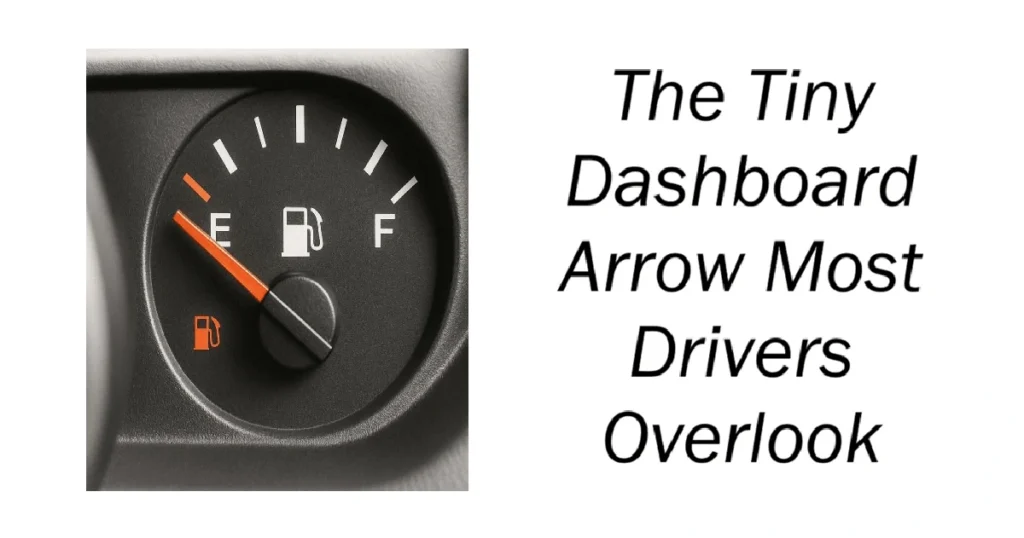
The Tiny Dashboard Arrow Most Drivers Overlook
You’ve probably seen it hundreds of times without ever really thinking about it.
There it is on your dashboard: a tiny arrow sitting beside the familiar fuel-pump icon. It doesn’t flash. It doesn’t beep. It doesn’t demand your attention.
It simply points.
And that tiny arrow quietly solves one of the most common little frustrations drivers face: figuring out which side of the car the fuel door is on.
The rule is wonderfully simple. If the arrow points left, the fuel door is on the left. If it points right, the fuel door is on the right.
No guessing. No pulling up to the wrong side of the pump. No awkwardly discovering that you’ve positioned the car incorrectly while a queue forms behind you.
For such a small detail, it can be surprisingly useful.
Why Does the Arrow Exist?
It wasn’t designed merely as a clever dashboard decoration.
As people began driving a wider variety of vehicles, relying on muscle memory became less practical. You might drive your own car every day, then jump into a rental, a family member’s vehicle, a company car, or a friend’s car—and suddenly, everything feels slightly unfamiliar.
Even something as simple as the location of the fuel door can change from one vehicle to another.
Automakers had an elegant solution: create a visual cue that required no instructions, no manual, and no words.
Just an arrow.
You Notice It When You Need It
Most of the time, you probably don’t think about the fuel arrow at all.
Then comes the moment when you’re running low on fuel, you’re tired, you’re in a hurry, or you’re driving a car you’ve never used before.
You pull into a petrol station and wonder:
Which side is the fuel door on?
Instead of guessing, getting out to check, or positioning the car incorrectly, you simply glance at the dashboard.
There’s your answer.
It takes barely a second, but that second eliminates an unnecessary decision at exactly the moment you don’t need another one.
The Genius Is in How Quiet It Is
What makes the fuel arrow such a good example of design is that it doesn’t try to impress you.
It doesn’t announce itself. It doesn’t interrupt your driving. It doesn’t demand that you learn anything complicated.
It simply waits until you need it.
That’s an important principle in good design: sometimes the best features are the ones you barely notice until the moment they become useful.
And once you understand what the arrow means, you’ll probably never forget it.
A Small Example of Better Car Design
Modern dashboards are full of subtle symbols and indicators designed to guide drivers without overwhelming them.
Some warn you about low temperatures. Others encourage more economical driving. Tire-pressure systems alert you when something needs attention. Many of these features operate quietly in the background, stepping forward only when they’re useful.
The fuel arrow belongs in the same category.
It isn’t preventing a major accident or solving a serious mechanical problem. It’s doing something much smaller: removing friction.
And that’s more valuable than it sounds.
Small inconveniences may seem insignificant individually, but when they happen repeatedly, they add unnecessary mental effort to everyday life. Good design removes those little obstacles wherever possible.
Even More Useful When You’re Away From Home
The arrow becomes especially helpful when you’re driving somewhere unfamiliar.
Think about a long road trip, a rental car, or borrowing someone else’s vehicle. You may know how to drive the car perfectly well, but you don’t necessarily know where everything is.
The fuel arrow gives you one small piece of information without requiring you to search through a manual or experiment.
It’s a simple visual language that works regardless of who made the car.
And perhaps that’s the most satisfying thing about it.
The arrow doesn’t judge you for forgetting. It doesn’t care whether you’ve driven the vehicle before. It doesn’t ask you to remember a complicated instruction.
It just points.
That’s what thoughtful design looks like: understanding what the driver needs, providing the answer at exactly the right moment, and then quietly getting out of the way.
So the next time you see that tiny arrow beside the fuel-pump symbol, take a second to appreciate it.
It may be one of the smallest features on your dashboard—but it’s also one of the smartest.
You’ve just read The Tiny Dashboard Arrow Most Drivers Overlook . Why not read The One You Chose May Reveal More Than You Think