
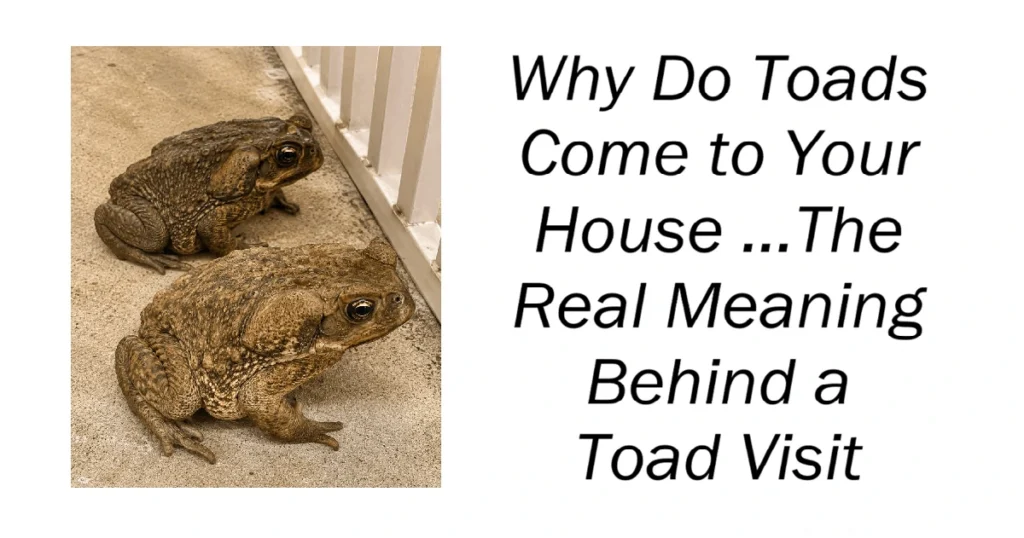
Why Do Toads Come to Your House …The Real Meaning Behind a Toad Visit
Seeing a toad sitting near your front door, patio, garage, or garden can feel strangely mysterious—especially when it appears after sunset or soon after heavy rain.
Across different traditions, a toad appearing near the home is sometimes associated with good luck, transformation, prosperity, or a message from nature. But from a scientific perspective, there is usually a much simpler explanation.
The toad has probably found something it needs.
Whether it is searching for food, moisture, shelter, or a route between habitats, your property may temporarily offer the right conditions. As amphibians, toads are particularly sensitive to temperature and moisture. Their permeable skin means they need environments that help prevent dehydration.
So, if a toad suddenly appears outside your home, its visit may tell you more about the surrounding environment than about the future.
1. Rain and Humidity Make It Easier for Toads to Move
One of the most common times to see toads is during rainfall or shortly afterward.
Damp ground and humid air reduce the risk of dehydration, allowing toads to leave their daytime hiding places and move across exposed areas more safely.
Rain also creates a buffet of potential prey. Earthworms may move closer to the surface, slugs become more active, and insects emerge in greater numbers. Some species that remain hidden underground during dry periods become active when moisture returns.
This can make it seem as though a toad has suddenly “arrived with the rain.”
In reality, it may have been nearby all along, sheltering beneath leaves, soil, rocks, logs, or other protected areas.
2. Outdoor Lights Can Turn Your Porch Into a Toad Buffet
Many toads are most active at night, when temperatures are cooler and humidity is often higher.
Unfortunately for insects—and conveniently for toads—outdoor lights can attract moths, beetles, crickets, flies, and other insects. A porch light or garden lamp can therefore create an excellent nighttime feeding area.
Toads are opportunistic predators and eat a wide variety of invertebrates, including beetles, slugs, snails, worms, ants, termites, and other insects.
So, if the same toad keeps returning to your porch, it may not be trying to tell you anything mysterious. It may simply know where dinner is served.
3. Your Garden May Provide the Perfect Hiding Place
During the day, toads generally avoid direct sunlight and dry, exposed ground. Instead, they look for cool, shaded places where they can remain protected from dehydration and predators.
A garden can provide plenty of suitable hiding spots. These might include:
- Fallen leaves and leaf litter
- Mulch and loose soil
- Dense vegetation
- Wood piles
- Spaces beneath steps
- Overturned flowerpots
- Drains and sheltered corners
- Gaps beneath outdoor structures
Some toads also use existing animal burrows or create shallow hiding places of their own.
If your property remains cooler and more humid than the surrounding area, it may become an attractive refuge, particularly during hot or dry weather.
4. There May Be Water Nearby
Although adult toads spend much of their time on land, water remains essential to their life cycle.
Many species return to ponds, wetlands, temporary pools, drainage areas, and other bodies of calm water to reproduce. Since their eggs and tadpoles develop in water, adult toads may travel through gardens and residential areas while moving between habitats.
Your property could contain an attractive water source, such as:
- A garden pond
- A rain garden
- A damp, low-lying area
- A leaking outdoor tap
- An air-conditioner drainage outlet
- A pet water bowl
- A consistently moist patch of soil
The toad may also simply be passing through on its way to a nearby breeding site.
If you maintain water features, however, avoid leaving neglected containers, blocked gutters, old tires, or buckets filled with stagnant water, as these can create mosquito breeding sites. Properly maintained ponds and regularly refreshed shallow water sources are safer options for a wildlife-friendly garden.
5. Your Garden May Have Plenty of Food
A regular toad visitor can also be a sign that your garden contains plenty of potential prey.
Toads eat many invertebrates that gardeners consider pests, including slugs, snails, beetles, grubs, and various insects.
That does not mean one toad will eliminate every pest in your garden. Claims about exactly how many insects a particular toad eats each night should also be treated cautiously.
Nevertheless, toads are genuine insect-eaters and can play a useful role in a healthy garden ecosystem.
Their presence may indicate that your garden has an abundant supply of invertebrates—or that something nearby, such as outdoor lighting, damp organic material, compost, or poor drainage, is attracting insects.
6. What If a Toad Gets Inside Your House?
Finding a toad in your garage, basement, bathroom, utility room, or even living area can be surprising.
Usually, however, the animal has not deliberately chosen your home as a permanent residence.
It may have entered through an open door, followed insects indoors, slipped through a small opening, or wandered inside while searching for somewhere cool and sheltered. Smooth floors, stairways, window wells, and deep containers can then make it difficult for the animal to escape.
If the toad appears healthy, avoid chasing, squeezing, or grabbing it unnecessarily.
Instead, keep children and pets away. You can carefully place a container over the toad, slide a firm piece of cardboard underneath, and gently carry it outdoors. Release it in a shaded location close to where you found it.
Keep handling to a minimum because amphibian skin is sensitive and can absorb substances from human hands.
Does a Toad Near Your Home Mean the Environment Is Healthy?
Possibly—but one toad cannot tell you the whole story.
Amphibians are often considered useful indicators of environmental conditions because their permeable skin and complex life cycles make them sensitive to changes in both land and water environments.
A property that supports toads may provide several things they need, including moisture, shelter, food, and access to breeding habitats.
However, seeing a single toad does not prove that the surrounding ecosystem is healthy or free from pollution.
Toads may also gather around houses because artificial lights attract insects, drainage problems create damp areas, or natural habitats have been disturbed.
Think of a toad’s presence as an ecological clue rather than a complete environmental health check.
Are Toads Dangerous?
Most toads are not aggressive. When threatened, they generally prefer to hide or escape rather than confront people.
And despite the familiar childhood myth, toads do not cause warts.
However, many true toads have defensive glands behind their eyes that produce irritating or toxic secretions. The strength of these secretions varies significantly between species. Some species, including cane toads and Sonoran Desert toads, can be particularly dangerous to animals that bite or lick them.
For this reason, keep pets from putting toads in their mouths. After accidental contact, wash your hands and avoid touching your eyes or mouth.
If a dog or another pet bites or licks a toad and begins showing signs of illness, contact a veterinarian promptly.
Should You Leave a Toad Alone?
In most situations, yes.
A toad found outdoors is generally best left where it is. It is a wild animal carrying out its normal role in the ecosystem, including feeding on invertebrates and serving as prey for other wildlife.
If you want to make your property safer and more welcoming for wildlife, consider:
- Reducing unnecessary pesticide and herbicide use
- Checking lawns and vegetation before mowing
- Supervising pets outdoors at night
- Covering deep window wells and other potential traps
- Repairing leaking pipes
- Removing unhealthy standing water
- Using outdoor lighting only when necessary
- Maintaining shaded vegetation or some leaf litter away from entrances and walkways
If you would rather not have toads gathering directly beside your home, changing the conditions is better than harming or relocating them unnecessarily.
Reducing outdoor lighting, sealing gaps beneath doors, removing excessive clutter around the foundation, and improving drainage can make the area less attractive to them.
So, What Does a Toad Visit Really Mean?
Why do toads come to your house?
Most of the time, the answer is surprisingly simple.
Your home is offering something the toad needs.
Perhaps rain has made the ground damp. Maybe insects are gathering beneath a porch light. Your garden might provide cool shelter, or a pond or wetland could be nearby. In some cases, the toad may simply be traveling between habitats.
Cultural traditions may give a toad’s appearance a symbolic meaning, but biologically, its visit is usually driven by basic needs: food, moisture, shelter, temperature, and reproduction.
The next time you spot a toad sitting quietly beside your front door, take a moment to look around.
Is the soil damp? Are insects gathering around a light? Is there dense vegetation nearby? Could there be a pond, drain, or other water source close by?
The answer may be right in front of you.
A toad at your doorstep may not be a supernatural warning or prediction. It may simply be a fascinating reminder that even our homes and gardens are connected to the natural world.
You’ve just read Why Do Toads Come to Your House. Why not read Unwanted Visitors in Your Child’s Hair