
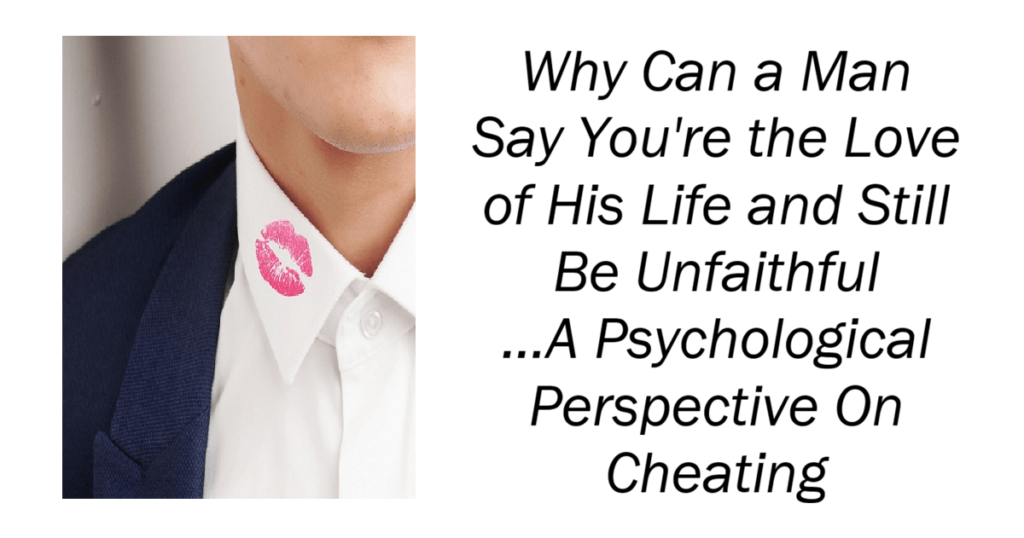
Why Can a Man Say You’re the Love of His Life and Still Be Unfaithful …A Psychological Perspective On Cheating
One of the most painful questions many people ask after experiencing infidelity is:
“How could someone look me in the eyes, tell me they love me, and still choose someone else?”
At first glance, it seems like an impossible contradiction. If someone truly loves their partner, why would they betray that relationship?
While every situation is different, psychologists suggest that infidelity is often more complicated than simply “falling out of love.” In many cases, it reflects unresolved emotional conflicts, poor coping skills, unmet needs, or personal struggles that have little to do with the partner.
Understanding these psychological dynamics doesn’t excuse betrayal—but it can help explain why it happens.
The Hidden Side of Human Psychology
Depth psychology proposes that every person has both a conscious and an unconscious side.
The conscious self is the part we show the world: our values, decisions, and the identity we present to others.
The unconscious contains emotions, fears, desires, insecurities, and unresolved experiences that may remain hidden—even from ourselves.
Swiss psychiatrist Carl Jung referred to this hidden part as the “shadow.”
When people become aware of these hidden aspects and learn to integrate them in healthy ways, they often develop greater emotional maturity. When those feelings remain ignored or suppressed, they can sometimes emerge through impulsive or self-destructive behaviors.
For some individuals, infidelity may be one expression of these unresolved internal conflicts.
Why Love and Betrayal Can Exist at the Same Time
Many people assume that cheating automatically means love has disappeared.
Psychology suggests the reality can be more complicated.
Some individuals genuinely care for their partner while simultaneously struggling with insecurity, emotional immaturity, poor impulse control, or a desire for validation.
This doesn’t justify betrayal, but it helps explain why human behavior can sometimes appear contradictory.
Three Psychological Forces That Can Create Inner Conflict
Many therapists describe human behavior as being influenced by several psychological processes that don’t always work together.
1. The Social Self
This is the version of ourselves we present to others.
It includes qualities such as responsibility, loyalty, kindness, and commitment.
This is often the part capable of building a loving, stable relationship.
2. The Shadow
The shadow contains emotions and impulses that people may avoid acknowledging.
These can include:
- Fear of vulnerability
- Repressed anger
- Feelings of inadequacy
- Desire for excitement or novelty
- Emotional wounds from the past
When these emotions remain unaddressed, they can influence behavior in unhealthy ways.
3. Idealized Expectations
Some people develop unrealistic fantasies about romantic partners.
Instead of seeing others as complex human beings, they become attracted to an idealized image or fantasy.
When reality doesn’t match that fantasy, they may begin searching elsewhere instead of addressing the underlying issues in the relationship.
Emotional Immaturity Can Increase Relationship Problems
Emotional maturity isn’t about being perfect.
It’s about recognizing emotions, accepting responsibility, communicating honestly, and making thoughtful decisions—even during difficult moments.
People who avoid emotional responsibility may be more likely to:
- Hide important parts of their lives
- Avoid difficult conversations
- Seek external validation
- Escape problems instead of solving them
Again, these behaviors don’t guarantee infidelity, but they can weaken trust within a relationship.
Signs That May Indicate Emotional Distance
No single behavior proves someone is being unfaithful.
However, relationship experts note that emotional distancing often appears before major relationship problems develop.
Possible signs include:
They Become More Secretive
They may begin separating different parts of their life, such as:
- Keeping social activities private
- Avoiding conversations about their day
- Becoming unusually protective of their phone or personal space
These changes don’t necessarily indicate infidelity, but they may signal emotional withdrawal.
Communication Declines
Open conversations become less frequent.
Emotional connection feels weaker, and important topics are avoided rather than discussed.
They Avoid Accountability
Emotionally immature individuals often blame circumstances or other people instead of accepting responsibility for their actions.
Healthy relationships require accountability from both partners.
What Emotional Maturity Looks Like
Emotionally mature partners generally share several characteristics.
They tend to:
- Admit mistakes without excessive defensiveness.
- Accept responsibility for their decisions.
- Communicate honestly, even during conflict.
- Respect boundaries.
- Show empathy toward their partner.
- Value mutual growth rather than control.
- Build trust through consistent actions.
Emotional maturity doesn’t mean someone never makes mistakes—it means they’re willing to learn from them.
Five Healthy Relationship Reminders
1. Watch Actions More Than Words
Affectionate words matter, but consistent behavior reveals true character over time.
2. Maintain Your Independence
Healthy relationships consist of two emotionally complete individuals who support each other—not two people who rely entirely on one another for their identity.
3. You Cannot Change Someone Who Doesn’t Want to Change
Growth is a personal decision.
You can encourage someone, but you cannot do the emotional work for them.
4. Trust Your Instincts—With Perspective
If something consistently feels wrong, don’t ignore it.
At the same time, avoid jumping to conclusions based on assumptions alone. Honest communication is always the healthiest first step.
5. Protect Your Emotional Well-Being
A healthy relationship should provide security, respect, and emotional support—not ongoing confusion, fear, or emotional exhaustion.
Final Thoughts
Infidelity is rarely explained by a single cause. Every relationship is unique, and every person’s motivations are different.
While psychological theories such as the concept of the “shadow” offer one way of understanding human behavior, no theory can fully explain every act of betrayal.
The healthiest relationships are built on honesty, accountability, emotional maturity, and mutual respect. Rather than trying to control another person’s choices, focus on building relationships where trust, communication, and personal growth are shared values.
Ultimately, understanding human psychology can help us make wiser decisions—not only about the partners we choose, but also about the relationships we choose to nurture.
You’ve just read A Psychological Perspective On Cheating . Why not read Natural Overnight Face Masks