
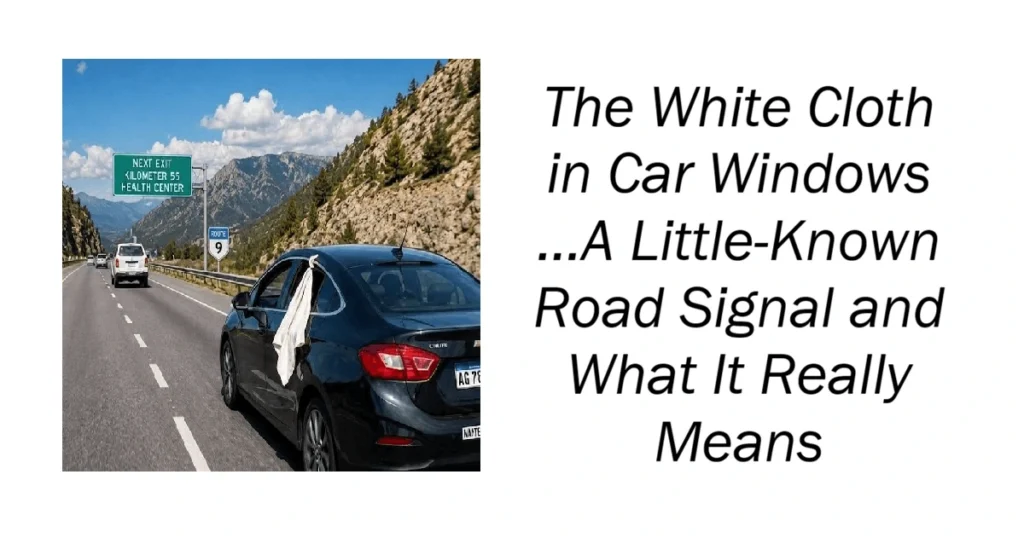
The White Cloth in Car Windows …A Little-Known Road Signal and What It Really Means
Driving involves interpreting a constant stream of signals—brake lights, indicators, road signs, and the behavior of other drivers. But occasionally, you might notice something less official and more puzzling: a white cloth hanging from a car window.
It’s not part of any highway code or driving regulation, yet it appears in different places around the world as an informal signal. So what does it actually mean, and how should drivers respond when they see it?
An Unofficial but Recognizable Road Signal
The white cloth is not mentioned in standard driving manuals or traffic laws. Instead, it has emerged as an informal, driver-created signal used to communicate that something is wrong inside or with the vehicle.
Unlike hazard lights or reflective warning triangles, this method relies on visibility and shared understanding among motorists rather than official regulation.
The use of white is also symbolic. Across many cultures, white is associated with peace, surrender, or a request for help. This is why some drivers interpret it as a sign that the vehicle is in distress and may need assistance.
Why Drivers Use a White Cloth
Although not standardized, this practice is generally associated with a few common situations:
1. Mechanical Breakdown
A car that has stopped due to a technical failure may display a white cloth to signal that it is immobilized and may need assistance. It also helps alert passing drivers to exercise extra caution.
2. Medical Emergency
In some cases, it is used to indicate that someone inside the vehicle is experiencing a medical emergency, and the occupants are trying to reach help as quickly as possible.
3. Group Travel Identification
During convoy travel, pilgrimages, funerals, or organized group trips, a white cloth may be used to help identify vehicles belonging to the same group.
4. Running Out of Fuel
Less commonly, it may indicate that the vehicle has run out of fuel and is temporarily unable to continue.
Does It Grant Any Special Right of Way?
A key misconception is that a white cloth gives a vehicle emergency status. This is not true.
Traffic laws only recognize official emergency vehicles—such as ambulances, police cars, fire engines, and authorized traffic enforcement vehicles—when they are using lights and sirens.
A private vehicle displaying a white cloth does not gain any legal priority. It cannot legally ignore traffic signals, exceed speed limits, or use restricted lanes.
While other drivers may choose to show courtesy, that decision is voluntary, not required by law.
How to Respond When You See One
If you encounter a vehicle with a white cloth hanging from a window, the safest approach is caution and awareness rather than assumption.
- Reduce speed gradually to avoid sudden braking.
- Maintain a safe distance from the vehicle.
- Observe the situation before deciding whether to assist.
- If there appears to be a serious emergency, contact local emergency services.
- Avoid engaging if the situation seems unsafe or unpredictable.
Helping others on the road is important, but it should never come at the cost of your own safety or that of other drivers.
Safety First: When to Help and When to Step Back
If the vehicle is stationary on the roadside and it is safe to do so, you may choose to stop at a safe distance, activate your hazard lights, and offer help or call roadside assistance.
However, in most cases, the safest and most effective action is to alert professionals who are trained to handle emergencies.
Why This Informal Practice Still Exists
The continued use of the white cloth reflects a gap in formal communication tools for drivers. Hazard lights indicate that a vehicle is stopped, but they don’t explain why.
In the absence of a standardized system, motorists developed their own informal signal to communicate distress. Over time, this practice has persisted in certain regions as a widely recognized—though unofficial—road cue.
Final Thoughts
The white cloth in a car window is not a legal signal, but it is a reminder of how drivers adapt to communicate in real-world situations. While it may indicate distress, it does not override traffic laws or replace official emergency protocols.
The safest response is always the same: stay alert, slow down, keep distance, and let trained emergency services handle the situation when needed.
On the road, awareness and caution matter more than interpretation—and safety should always come first.
You’ve just read The White Cloth in Car Windows. Why not read The Hidden Power of Vinegar