
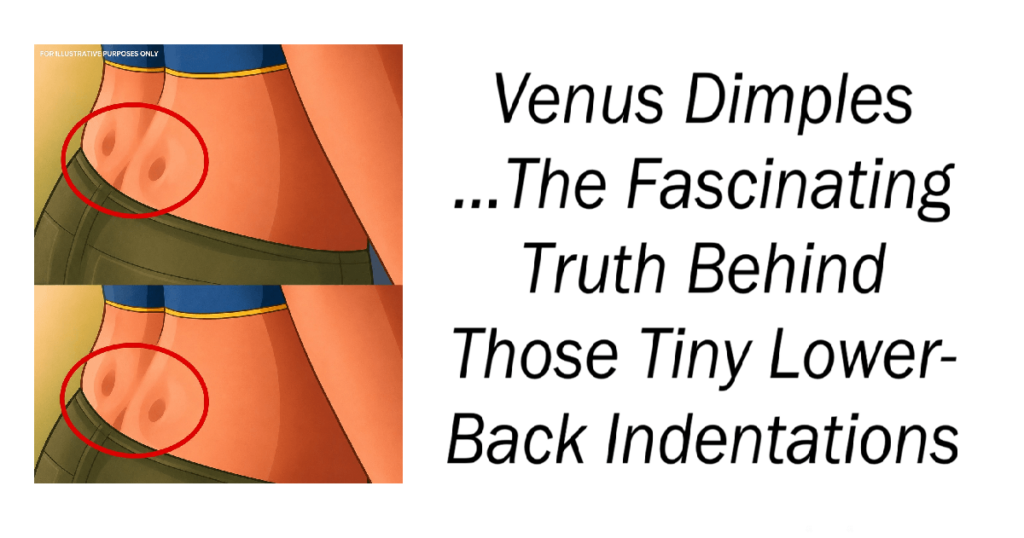
Venus Dimples …The Fascinating Truth Behind Those Tiny Lower-Back Indentations
Have you ever noticed two small, symmetrical indentations just above the buttocks on the lower back? Often called Venus dimples, these subtle features have captured attention for centuries and are frequently associated with beauty, fitness, and attractiveness.
Despite their popularity in art, fashion, and fitness culture, Venus dimples are not a result of special exercises or superior health. In reality, they are simply a fascinating example of human anatomy and genetics at work.
So, what exactly are Venus dimples, and why do some people have them while others don’t?
What Are Venus Dimples?
Venus dimples are small indentations located on the lower back where the pelvis connects to the spine.
Medically, they are known as fossae lumbales laterales and appear near two bony points called the posterior superior iliac spines (PSIS).
These dimples form because a short ligament connects the skin directly to the underlying pelvic bone. When this ligament naturally pulls the skin inward, a visible indentation appears.
They are completely harmless, painless, and considered a normal variation in human anatomy.
Although most commonly discussed in women, men can have them too. In men, they are sometimes referred to as Apollo dimples, named after the mythological figure associated with strength and athleticism.
Why Do Some People Have Them?
The primary reason is genetics.
Just as some people inherit freckles, facial dimples, or certain eye colors, Venus dimples are largely determined by the anatomical structure you are born with.
If close family members have them, you are more likely to have them as well.
Body Composition Plays a Role
While genetics determine whether the dimples can form, body composition affects how visible they appear.
People with:
- Lower body-fat percentages
- Greater muscle definition
- Leaner lower backs
often display more noticeable Venus dimples.
This explains why some physically fit individuals have very prominent dimples, while others never develop visible ones despite maintaining excellent fitness.
Without the underlying ligament structure, no amount of exercise can create true Venus dimples.
Can Exercise Create Venus Dimples?
One of the most common myths is that specific workouts can create Venus dimples.
The truth is that exercise cannot create them if your anatomy does not naturally include the necessary ligament structure.
However, exercise can enhance the appearance of existing Venus dimples by reducing body fat and improving muscle tone around the lower back and hips.
Exercises That May Increase Definition
If you naturally have Venus dimples, the following exercises may make them more noticeable:
- Deadlifts
- Squats
- Lunges
- Back extensions
- Planks
These exercises strengthen the posterior chain—the muscles of the lower back, glutes, and hamstrings—helping improve overall body definition.
Are Venus Dimples a Sign of Good Health?
Over the years, Venus dimples have become surrounded by various health-related claims.
Some sources suggest they indicate:
- Better circulation
- Enhanced fertility
- Increased physical vitality
- Improved sexual function
However, there is no scientific evidence supporting these claims.
Medical professionals consider Venus dimples to be purely anatomical features. Their presence does not indicate superior health, fitness, circulation, or athletic ability.
The misconception likely stems from the fact that Venus dimples tend to be more visible in lean individuals, creating an association between the dimples and physical fitness.
Venus Dimples Throughout History
Venus dimples have long been admired in art and culture.
Named after Venus, the Roman goddess of love and beauty, these lower-back indentations have often been portrayed as symbols of elegance and physical attractiveness.
Classical sculptors and Renaissance artists frequently emphasized the natural contours of the human body, including these subtle features.
Today, Venus dimples remain popular in:
- Fitness photography
- Fashion imagery
- Social media
- Beauty discussions
Many people appreciate them as a unique physical characteristic that adds individuality to a person’s appearance.
A Reminder About Body Diversity
While Venus dimples are often celebrated aesthetically, it’s important to remember that not having them is completely normal.
They are not:
❌ A sign of better health
❌ A measure of physical fitness
❌ An indicator of attractiveness
❌ Something everyone can develop
Like many physical traits, their presence simply reflects genetic variation.
Final Thoughts
Venus dimples may be small, but they offer an interesting glimpse into the complexity of human anatomy.
Whether they’re highly visible or absent altogether, these lower-back indentations are determined largely by genetics rather than lifestyle or exercise. While they have earned a reputation as a symbol of beauty over the centuries, they are ultimately just one of countless ways the human body can vary from person to person.
At the end of the day, confidence, overall health, and self-care matter far more than any single physical feature. Venus dimples may be fascinating, but the real beauty lies in embracing the unique characteristics that make each of us different.