
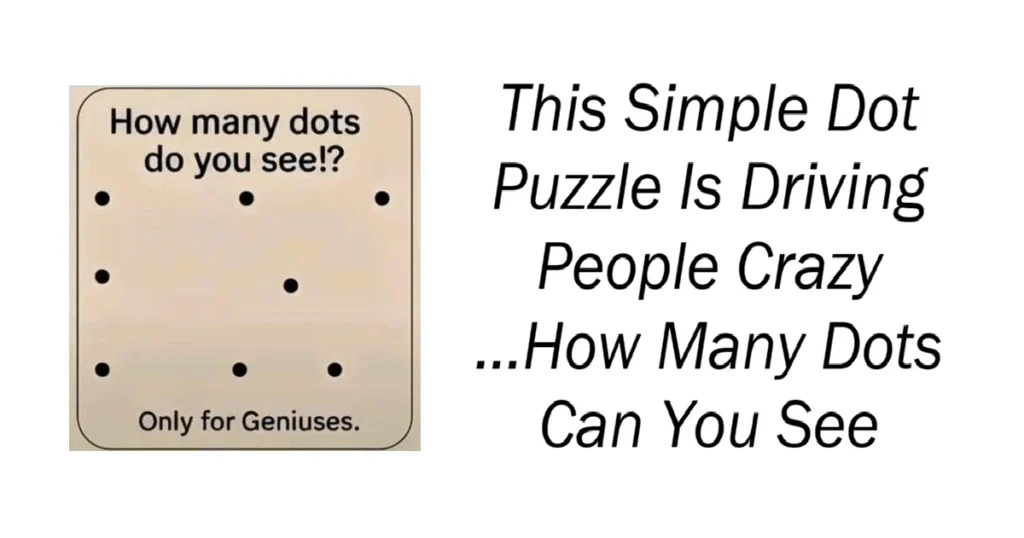
This Simple Dot Puzzle Is Driving People Crazy …How Many Dots Can You See
At first glance, it seems incredibly easy.
Just a bunch of dots on a page, right?
But within seconds, people start second-guessing themselves. Was that dot already counted? Is that one hidden in the background? Wait… are some of them overlapping?
Suddenly, a puzzle that looked simple turns into a surprisingly frustrating brain teaser.
And that’s exactly why this classic dot challenge continues to confuse, entertain, and spark debates online.
So the real question is: How many dots do you actually see?
Why This Puzzle Tricks Your Brain
The human brain is designed to process information quickly and efficiently. Most of the time, that’s helpful. It allows us to recognize patterns, ignore unnecessary details, and make fast decisions.
But visual puzzles like this take advantage of those shortcuts.
Instead of carefully analyzing every single dot, your brain may:
- Group nearby dots together
- Ignore faint or partially hidden dots
- Fill in gaps automatically
- Misjudge spacing and depth
As a result, two people can stare at the exact same image and confidently come up with completely different answers.
And both may genuinely believe they’re correct.
The Psychology Behind What You See
Interestingly, puzzles like this reveal more than just eyesight.
They also highlight differences in how people process visual information.
Fast Counters
People who answer quickly often rely on pattern recognition and instinct. Their brains process the image as a whole rather than focusing on tiny details.
Careful Counters
People who count slowly and methodically tend to focus more on accuracy and detail. They’re more likely to double-check sections and avoid assumptions.
Neither approach is wrong — they simply reflect different thinking styles.
Why Your Answer Might Change
One of the strangest things about this challenge is that your answer can shift every time you look at it.
You may count:
- 12 dots the first time
- 14 the second time
- Then suddenly notice 2 more hidden in the corners
That’s because your brain adjusts its focus as you continue observing the image.
The longer you stare, the more details begin to emerge.
Tips to Count the Dots More Accurately
Think you missed some? Try these tricks before counting again:
Break the Image Into Sections
Instead of scanning everything at once, focus on one small area at a time.
Step Back From the Screen
Changing your viewing distance can help hidden shapes or faded dots become easier to notice.
Cover Parts of the Image
Blocking sections prevents your brain from becoming overwhelmed by the entire pattern.
Look Away and Return
A quick visual reset can help your eyes notice details they ignored before.
You’ll be surprised how different the image looks after a short break.
Why Visual Brain Teasers Are So Addictive
There’s a reason puzzles like this spread so quickly online.
They’re:
- Simple to understand
- Fast to try
- Challenging enough to spark curiosity
- Perfect for comparing answers with friends
But beyond entertainment, visual brain teasers also help:
- Improve focus
- Strengthen observation skills
- Exercise the brain
- Encourage mindful attention to detail
And honestly, they’re just fun to argue about.
So… What Number Did You Get?
Did you spot all the dots immediately?
Or did the number keep changing every time you looked?
That’s the magic of optical and visual puzzles — they remind us that perception isn’t always as straightforward as we think.
Sometimes, what we see depends just as much on how we look.
You’ve just read This Simple Dot Puzzle Is Driving People Crazy. Why not read Brittle Nails