
Which Glass Contains the Most Water …This Simple Puzzle Is Tricking Thousands of People
At first glance, the answer seems obvious.
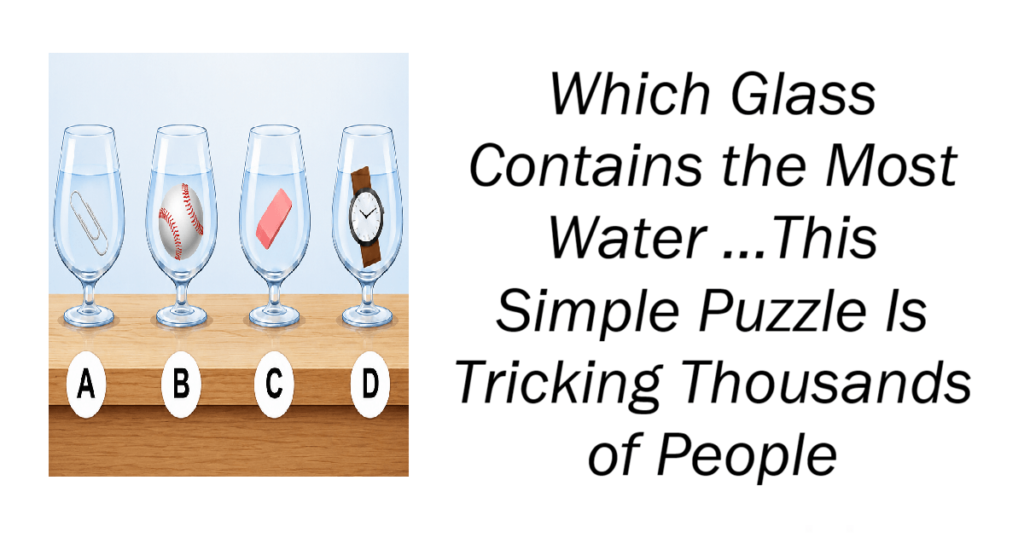
Four identical glasses labeled A, B, C, and D are each filled with water. Inside every glass sits a different object. Your task is simple:
Which glass actually contains the most water?
Easy enough… or is it?
This deceptively simple visual puzzle has been confusing people all over the internet because the correct answer has less to do with appearance and more to do with science.
Take a closer look before reading ahead — which one would you choose?
The Objects Inside the Glasses
Each glass contains a different item:
- Glass A: Paperclip
- Glass B: Baseball
- Glass C: Eraser
- Glass D: Wristwatch
At first, many people assume all four glasses contain the same amount of water because the water levels appear identical.
But that’s exactly where the trick lies.
The Secret Is Water Displacement
To solve this puzzle, you need to think about one important scientific principle: displacement.
When an object is placed into water, it takes up space inside the glass. The larger the object, the more water it displaces.
That means:
- Bigger objects leave less room for water
- Smaller objects leave more room for water
So even if the water level looks the same in every glass, the actual amount of water is different.
The Correct Answer
✅ Glass A contains the most water.
Why?
Because the paperclip is the smallest object among the four. It occupies the least amount of space inside the glass, allowing more water to fit inside.
Meanwhile:
- The baseball in Glass B takes up a large amount of space
- The watch in Glass D is relatively bulky
- The eraser in Glass C also displaces more water than the paperclip
So while all the glasses may appear equally full, Glass A actually contains the greatest volume of water.
Sometimes the smallest detail changes everything.
What Your Answer Might Reveal About You
Now for the fun part.
Although this puzzle has a logical solution, many people answer based on instinct or visual perception. That’s why personality-style interpretations often become part of puzzles like these.
Of course, these descriptions are just for entertainment — but they can still be surprisingly relatable.
If You Chose A (Paperclip)
You probably think analytically and notice details others miss. You tend to rely on logic rather than assumptions and often approach problems carefully before making decisions.
People may see you as:
- Observant
- Practical
- Intelligent
- Detail-oriented
If You Chose B (Baseball)
You likely trust your instincts and make quick decisions confidently. You may rely more on first impressions and visual judgment than deep analysis.
Your strengths may include:
- Confidence
- Energy
- Fast thinking
- Decisiveness
If You Chose C (Eraser)
You probably balance logic with creativity. You enjoy exploring different possibilities before settling on an answer and tend to stay open-minded.
You may be:
- Thoughtful
- Flexible
- Curious
- Creative
If You Chose D (Watch)
You may think more symbolically or emotionally than logically. You’re often drawn to deeper meaning, reflection, and interpretation beyond what’s immediately visible.
People might describe you as:
- Reflective
- Intuitive
- Emotional
- Imaginative
Why People Love Visual Puzzles Like This
Puzzles like this spread quickly online because they challenge the way we think.
They force us to:
- Question first impressions
- Look beyond appearances
- Think critically
- Notice hidden details
More importantly, they remind us of something important about life itself:
What appears true at first glance isn’t always the full story.
Sometimes the smallest, least noticeable detail completely changes the answer.
Final Thoughts
Whether you answered correctly or not, the real value of this puzzle isn’t just the solution — it’s the thinking process behind it.
Did you rely on:
- Logic?
- Instinct?
- Visual perception?
- Assumptions?
In everyday life, just like in this puzzle, those who slow down, observe carefully, and think a little deeper often notice what others miss.
And sometimes, the smallest object in the room holds the biggest clue.
You’ve just read Which Glass Contains the Most Water . Why not read The Truth About Nuts and Brain Health