
How Many Number 3s Can You Find …The Optical Illusion Everyone Is Talking About
At first glance, the image seems completely ordinary.
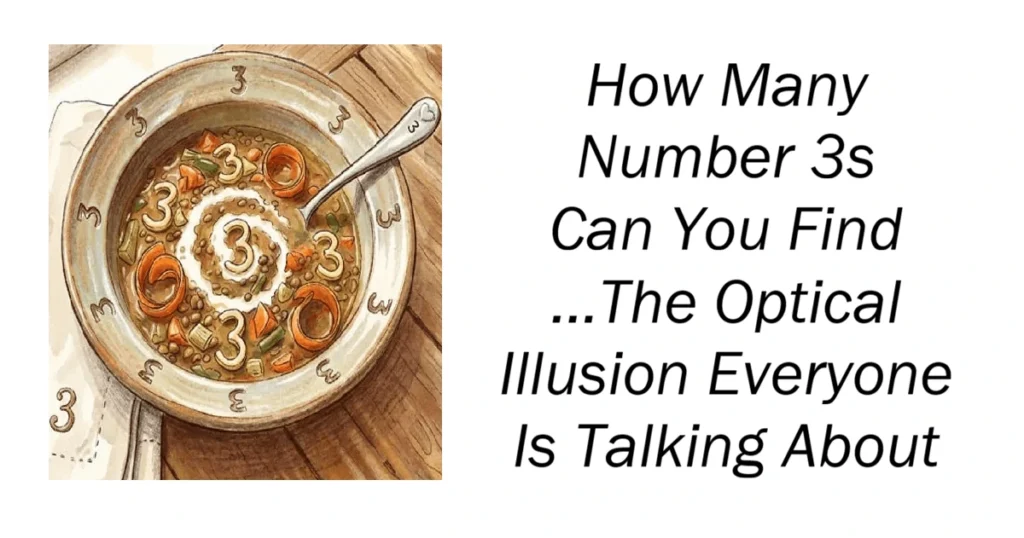
A warm bowl of soup sits quietly on a wooden table. Steam rises softly into the air. A spoon rests beside the bowl, creating the kind of cozy scene you might expect on a peaceful afternoon at home.
Nothing unusual.
At least, not right away.
But the longer you stare at the picture, the stranger it becomes.
Suddenly, curves begin to look intentional. Shadows start forming recognizable shapes. What first appeared decorative slowly transforms into something your brain can’t ignore.
The number 3 starts appearing everywhere.
Once you notice one, you begin spotting another. Then another.
Some people find only a few hidden threes.
Others keep discovering more long after everyone else has stopped looking.
And according to viral posts online, the number of threes you spot is supposed to reveal something about your personality — even hinting at traits connected to ego, control, or self-focus.
But before taking those claims seriously, it helps to understand what’s actually happening inside your brain.
What Is This Optical Illusion Really Showing?
This image is a classic example of a pattern-recognition illusion.
The number three has been subtly woven into different parts of the scene, including:
- The curve of the bowl
- Ripples in the soup
- Shapes formed by vegetables or pasta
- The outline of the spoon
- Background details and shadows
Some of the hidden threes are obvious.
Others blend almost perfectly into surrounding shapes, making them difficult to notice unless your brain actively starts searching for them.
That’s the fascinating part.
Your eyes don’t instantly “see” every three.
Your brain decides what counts as one.
And once the mind begins recognizing a pattern, it often keeps scanning for more.
Why People See Different Numbers
Here’s the important thing:
There is no official correct answer.
This illusion isn’t a test with a score.
Instead, it demonstrates how differently people process visual information.
Some people glance quickly, identify the most obvious shapes, and feel satisfied moving on.
Others naturally slow down, double-check details, and continue searching once they realize more hidden patterns might exist.
Neither response is right or wrong.
They simply reflect different styles of attention and observation.
The Viral Personality Claims — Are They True?
Online posts often attach personality meanings to the number of threes people find.
The interpretations usually look something like this:
Seeing Only a Few Threes
Often described as practical, grounded, or focused only on what stands out immediately.
Seeing a Moderate Number
Associated with curiosity, balance, and awareness.
Seeing Many Threes
This is where the claims become dramatic — suggesting competitiveness, overthinking, narcissism, or controlling behavior.
But here’s the truth:
These interpretations are not backed by psychology or science.
An optical illusion cannot diagnose personality traits, emotional health, or psychological conditions.
Human personality is far too complex to be measured through a single image.
What the Illusion Actually Reveals
Rather than exposing hidden personality flaws, this illusion mainly reflects how attention and pattern recognition work.
It may highlight things like:
- How long you stay engaged with a task
- Whether you enjoy searching for hidden details
- How quickly your brain recognizes patterns
- Whether curiosity keeps you exploring
People who find many threes are often simply more visually persistent or detail-oriented in that moment.
Once the brain realizes hidden shapes exist, it becomes motivated to keep looking.
That isn’t narcissism.
It’s curiosity.
Meanwhile, others may understand the concept quickly and feel no need to continue scanning.
Both reactions are completely normal.
Why Optical Illusions Spread So Quickly Online
There’s a reason images like this become viral sensations.
They tap into something deeply human:
- Curiosity
- Self-reflection
- Comparison
- The desire to discover hidden meaning
These illusions invite people to participate instantly without needing effort or expertise.
They also spark conversation:
“How many did you find?”
“Wait, where’s that one?”
“I still can’t see it!”
Most importantly, they create the feeling that something personal has been revealed — even when the experience is mostly playful entertainment.
And our brains love that feeling.
A Small Reality Check
If you only spotted a few threes, it doesn’t mean you lack intelligence or depth.
If you found dozens, it doesn’t mean you’re self-absorbed or controlling.
It simply means your brain interacted with the image in its own unique way.
Perception changes constantly depending on:
- Focus
- Mood
- Patience
- Lighting
- Stress levels
- Curiosity
That’s why two people can look at the exact same image and experience it completely differently.
The Real Takeaway
This illusion isn’t really about numbers.
It’s about how easily the human mind begins searching for meaning once curiosity is activated.
Whether you spotted three hidden threes or thirty, the image says nothing definitive about your personality or character.
But it does remind us of something fascinating:
Our brains are natural pattern-finding machines.
And once the search begins, it’s surprisingly hard to stop.
Sometimes, that’s not a weakness.
It’s simply part of being human.
You’ve just read How Many Number 3s Can You Find. Why not read Routine That May Help Skin Look Smoother and More Hydrated