
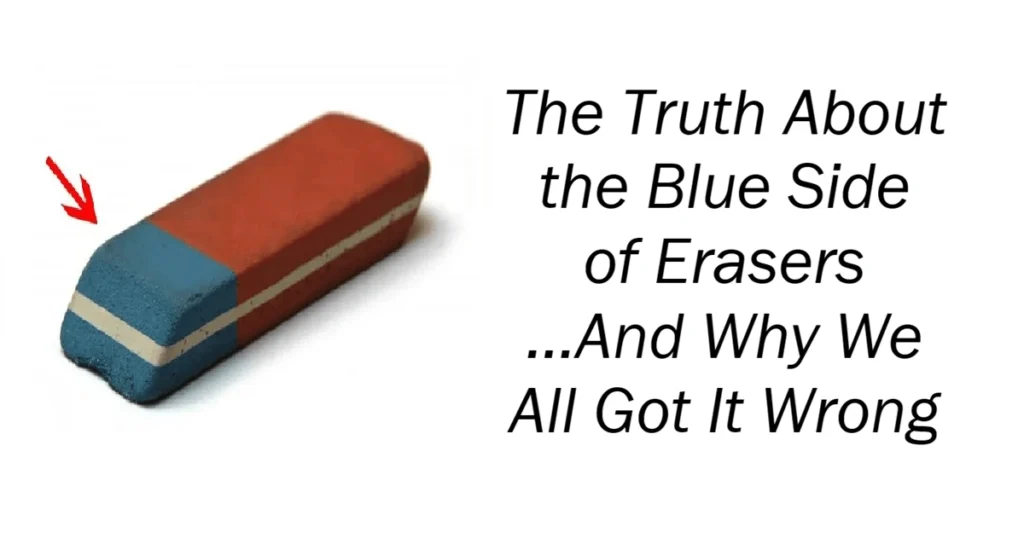
The Truth About the Blue Side of Erasers …And Why We All Got It Wrong
If you went to school, chances are you remember the classic pink-and-blue eraser—the one that lived in pencil cases, desk drawers, and the occasional last-minute exam panic.
And like many students, you were probably told one simple “fact”:
the blue side erases pen ink.
It sounded convincing. It spread quickly. And for years, most people never questioned it.
But here’s the reality—the blue side isn’t magical. It’s mechanical. And once you understand how it actually works, a lot of childhood confusion suddenly makes sense.
A Clever Two-in-One Design
That familiar eraser wasn’t just about color—it was about function.
The soft pink (or sometimes white) side is designed for everyday use. It gently removes pencil marks without damaging the paper, making it perfect for writing and light corrections.
The blue side, on the other hand, is built differently. It’s firmer, rougher, and far more abrasive. Think of it less like a gentle eraser—and more like a precision tool for tougher jobs.
The idea was simple: one eraser, two purposes.
What the Blue Side Really Does
Unlike the soft side, which lifts graphite off the page, the blue section works by scraping.
Literally.
It removes pencil marks by wearing down the top layer of the paper’s surface. This makes it surprisingly effective for:
- Dark, heavy pencil marks
- Deep shading in drawings
- Graphite pressed firmly into textured paper
In situations where a normal eraser struggles, the blue side steps in with extra strength.
Why It Often Ruins Your Paper
If you ever used the blue side on a notebook page, you probably learned the hard way—it’s not exactly gentle.
Because it removes part of the paper itself, it can easily cause:
- Thinning pages
- Rough or fuzzy patches
- Scratches
- Tears (especially on thin paper)
So while it does erase stubborn marks, it often leaves behind visible damage. That’s why it’s not ideal for everyday schoolwork.
The Ink Myth (Finally Explained)
Let’s clear this up once and for all:
the blue side was never designed to erase ink.
Ink behaves very differently from pencil marks. It soaks into the fibers of the paper, bonding more deeply than graphite ever does.
So when the blue eraser appears to remove ink, it’s not actually erasing it—it’s scraping away the top layer of paper where the ink sits.
That’s why the result is usually a damaged page, not a clean correction.
When the Blue Side Is Useful
Despite its reputation, the blue section isn’t useless—it’s just misunderstood.
It works best in situations where durability matters more than delicacy, such as:
- Sketching and detailed artwork
- Thick paper or cardstock
- Rough or textured surfaces
- Cleaning up heavy graphite shading
Some artists even use it intentionally to create highlights or refine drawings—but always with a careful hand.
Why It Was Made in the First Place
Before high-quality erasers became widely available, people often needed different tools for different tasks.
Instead of carrying multiple erasers, manufacturers combined both functions into one:
- A soft side for precision
- A rough side for power
It was practical, efficient, and ahead of its time—even if it caused a bit of confusion along the way.
A Lesson from the Classroom
For many people, the blue side became memorable not because it worked perfectly—but because it didn’t.
It tore pages. It left marks. It felt like using the wrong tool in the wrong situation.
And yet, it stuck around—partly because it could handle stubborn pencil marks better than softer erasers available at the time.
Final Thoughts
The blue side of an eraser isn’t a mystery or a hidden trick—it’s simply a more abrasive surface designed for heavy-duty use.
It’s effective, but not subtle. Powerful, but not forgiving.
So if you ever wondered why it seemed to “fail” you back in school, the answer is simple:
you weren’t using it wrong—you were just using it in the wrong context.
And sometimes, even the smallest tools come with a learning curve.
You’ve just read The Truth About the Blue Side of Erasers . Why not read My MIL Hijacked Christmas and Took the Credit