
Can Your Fingertips Really Reveal Your Personality
It’s a fascinating idea: that something as small as the shape of your fingertips could quietly reveal your strengths, your emotional style, even how you handle stress or relationships.
This belief comes from palmistry—an ancient tradition found in many cultures, where the hand is seen as a map of personality and life patterns. And while modern science doesn’t support these claims as measurable facts, the symbolism continues to intrigue people for a simple reason: it feels personal.
So let’s explore it—but with a clear, grounded lens.
The Four Classic Fingertip Shapes (According to Palmistry)
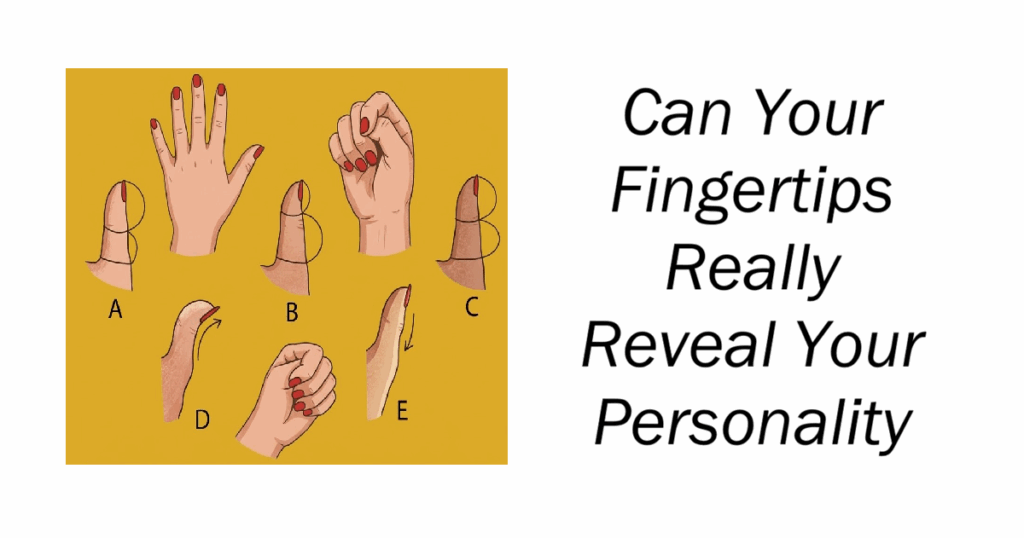
Palmistry groups fingertips into four main types. Think of these less as “truths” and more as personality archetypes—ways people like to interpret human behavior.
Round Fingertips
Often associated with calm, gentle personalities.
People in this category are said to value harmony, avoid conflict, and thrive in emotionally safe environments. They’re seen as empathetic and caring—but sometimes more sensitive to stress.
Symbolically: the peacemakers.
Pointed Fingertips
Linked to imagination and intuition.
These individuals are often described as creative, idealistic, and drawn to beauty or deeper meaning. They may have vivid inner worlds—but can struggle when reality doesn’t match their expectations.
Symbolically: the dreamers.
Square (or Flat) Fingertips
Associated with logic and structure.
People with this shape are thought to be practical, organized, and grounded. They prefer clear systems, stable routines, and rational decision-making.
Symbolically: the planners.
Spade-Shaped Fingertips
Connected to action and innovation.
These individuals are often described as energetic, curious, and hands-on problem-solvers. They like movement, change, and challenges—and tend to resist routine.
Symbolically: the explorers.
What About Your Thumb?
In palmistry, the thumb represents willpower and decision-making.
- A flexible thumb (sometimes called “hitchhiker’s thumb”) is said to reflect adaptability, openness, and emotional sensitivity.
- A straight, stiff thumb is associated with determination, discipline, and strong boundaries.
Again, these are symbolic interpretations—not biological indicators of personality.
What Science Actually Says
Here’s the important reality check:
There’s no scientific evidence that fingertip shapes determine personality, emotional traits, or life outcomes. Fields like psychology and neuroscience don’t support these connections.
What is real, though, is something else entirely:
Humans naturally look for patterns to understand themselves.
Systems like palmistry work because they:
- Offer simple categories we can relate to
- Encourage self-reflection
- Help people articulate traits they already feel
In other words, the value isn’t predictive—it’s reflective.
Why People Still Love These Ideas
Even without scientific backing, concepts like fingertip reading remain popular because they tap into something deeper:
- The desire to understand who we are
- The curiosity about hidden traits
- The comfort of seeing ourselves in a story
And when used lightly, they can actually be useful—as prompts for self-awareness.
A Balanced Takeaway
Your fingertips don’t secretly encode your destiny, your personality, or your future.
But paying attention to ideas like these can still spark something meaningful:
- Reflection on your strengths
- Awareness of your habits
- Curiosity about how you relate to others
So if you look at your hands and see a “type,” take it as an invitation—not a definition.
Final Thought
Your hands do tell a story—but not because of their shape.
They tell it through what you build, who you support, the risks you take, and the choices you make over time.
And that story is far more powerful than any label.
You’ve just read Can Your Fingertips Really Reveal Your Personality . Why not read How to Fix Bleach Stains on Colored Clothes