
How Many Monkeys Do You See …The Psychology Behind What We Notice
At first glance, the image looks simple—almost playful.
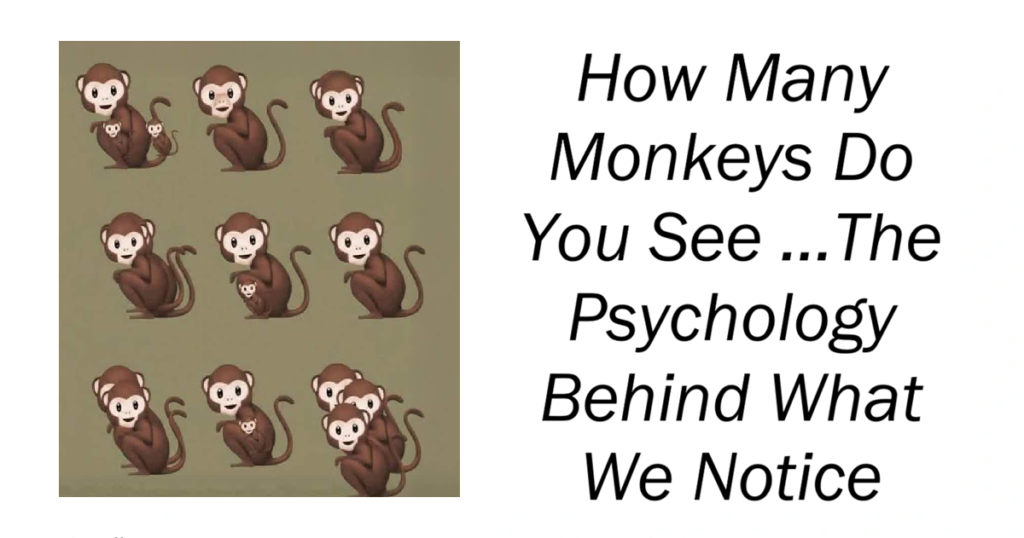
Rows of cute cartoon monkeys, neatly arranged against a plain background. Nothing complicated. Nothing unusual.
But then you read the caption: “The number of monkeys you see determines if you’re a narcissist.”
And just like that—you stop scrolling.
You start counting.
But Here’s the Twist…
This image isn’t really about monkeys.
It’s about how you see.
Some people glance quickly and count a straightforward number—one monkey per position. Done.
Others pause a little longer.
They start noticing something different:
- Smaller monkeys hidden within larger ones
- Subtle variations in shapes
- Overlapping details that weren’t obvious at first
Suddenly, the number changes.
And that raises a fascinating question:
Why do people see different things in the exact same image?
Your Brain Isn’t Just Seeing—It’s Interpreting
Human perception isn’t a perfect recording of reality. It’s more like a smart filter.
Your brain constantly processes visual information using what psychologists call Heuristics—quick mental shortcuts that help you make sense of the world faster.
In doing so, it relies on:
- Past experiences
- Expectations
- Focus and attention
- Pattern recognition
That’s why two people can look at the same image and walk away with completely different answers.
Some focus on the obvious.
Others dig deeper.
The Narcissism Claim: Truth or Clickbait?
Let’s clear this up:
There’s no scientific evidence linking how many monkeys you see to Narcissistic Personality Disorder.
The claim is a classic example of viral psychology bait—content designed to spark curiosity, trigger emotion, and get people to engage.
It works because it feels personal.
But while it doesn’t diagnose anything, it does reveal something real—just not what the caption suggests.
What It Might Say About You
Instead of labeling personality, this kind of illusion highlights different ways people process visual information.
- If you see fewer monkeys:
You may naturally focus on the bigger picture, filtering out smaller details. - If you see more monkeys (including hidden ones):
You might be more detail-oriented, picking up on subtle patterns others miss.
Neither approach is better.
They’re simply different cognitive styles.
Why These Illusions Go Viral
There’s a reason images like this spread so quickly.
They tap into three powerful human instincts:
- Curiosity: “Wait… did I miss something?”
- Self-reflection: “What does this say about me?”
- Comparison: “What did everyone else see?”
They turn a simple image into a shared experience—one that feels both personal and social at the same time.
Final Thought
In the end, this isn’t really about monkeys—or even personality.
It’s about awareness.
What you see at first glance isn’t always the full story. And sometimes, taking a second look reveals details you didn’t even realize were there.
So go ahead—look again.
How many monkeys do you see now?
You’ve just read How Many Monkeys Do You See. Why not read Ways You’re Attracting Pests Without Realizing It