
My Stepmom Favoured Her Son My Whole Life …The Will Changed Everything
I was sixteen the first time I truly understood where I stood in my stepmother’s world.
Her son, Ryan, had just turned eighteen. She threw him a birthday party that looked like something out of a magazine—balloons arched over the entrance of a downtown event hall, a live band, catered food I couldn’t even pronounce. Guests arrived with envelopes and wrapped boxes stacked higher than the gift table could hold. She wore a new dress, glowing with pride, telling anyone who would listen, “My boy deserves the best.”
I stood near the back with a plastic cup of soda, watching her beam at him as if the sun rose and set on his smile.
Two weeks later, it was my birthday.
There was no party. No cake. Just a folded bill pressed into my palm as we stood in the kitchen. Fifty dollars.
“Be grateful,” she said briskly, already turning back to the sink. “Some kids don’t get anything.”
“I am,” I replied—and on the surface, I meant it. I smiled. I thanked her. I didn’t mention Ryan’s party or the five thousand dollars she’d spent without blinking. I’d stopped expecting fairness a long time ago. Expecting it only made the disappointment sharper.
My dad noticed. He always did. But he was tired—always tired. He’d say things like, “She means well,” or “You know how she is,” as if those words could smooth over years of imbalance.
So I learned to be quiet.
To keep my head down.
To accept scraps without complaint.
A year later, she died suddenly.
An aneurysm, they said. One moment she was there, the next she wasn’t. The house felt wrong without her—too quiet, like it was holding its breath. People came and went with casseroles and condolences. Ryan moved through it all like a prince in mourning, accepting hugs and nodding solemnly.
At the funeral, I stood beside my father when Ryan leaned over and whispered, just loud enough for me to hear, “Maybe she left you another fifty bucks.”
He smirked, waiting for a reaction.
I didn’t give him one. I kept my eyes forward, hands folded, jaw tight. Grief does strange things to people—but cruelty like that doesn’t come from nowhere. It grows from entitlement, watered daily.
A week later, we sat in a lawyer’s office that smelled faintly of old paper and coffee. Ryan lounged in his chair, confidence radiating off him. I sat straight, hands clasped in my lap, prepared for nothing. I assumed everything would go to him. That was how it had always been.
The lawyer adjusted his glasses and began to read.
There were instructions for debts, donations, small gifts to distant relatives. Ryan perked up when the house was mentioned, already nodding as if it were a formality.
Then the lawyer paused.
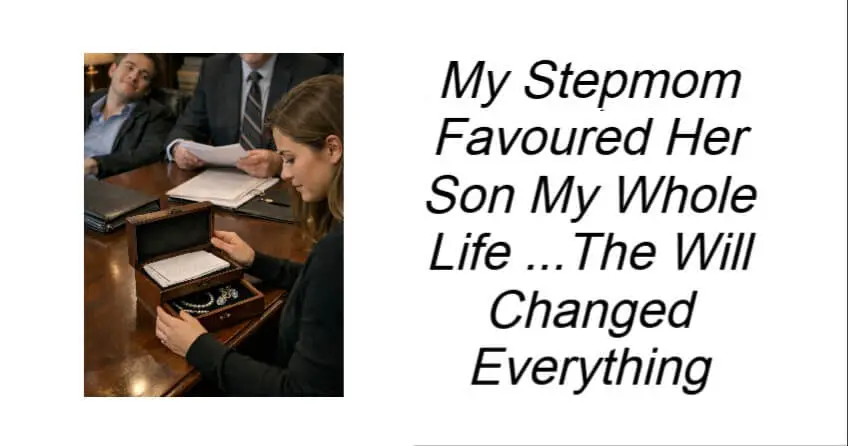
“There is one more item,” he said, reaching beneath the desk. He placed a small wooden box gently on the table. “This is addressed to you.”
He slid it toward me.
My name was written on the lid.
The room went still.
Ryan let out a short, disbelieving laugh. “What’s that supposed to be?”
I opened the box with shaking hands. Inside were documents—deeds, bank confirmations, appraisals. The house. Fully paid off. Beneath the papers, wrapped carefully in velvet, was her jewelry. The same pieces she’d worn to Ryan’s party. The ones she once told me were “too valuable to trust lying around.”
The lawyer cleared his throat. “Per her wishes, the property and these items are to be transferred to you.”
Ryan shot to his feet. “That’s impossible. She wouldn’t. This has to be a mistake.”
The lawyer met his gaze calmly. “It is not.”
I didn’t know what to feel. Shock, yes. Confusion. And a strange, aching sadness. Because the truth settled in slowly and painfully: she had known exactly what she was doing all those years. She had seen the imbalance, the quiet hurt, the way I learned to disappear. And she had chosen silence—until the very end.
Ryan stormed out. My father stared at me as if seeing me for the first time, eyes wet, mouth trembling. “She… she never said anything,” he whispered.
I closed the box.
I didn’t feel triumphant. I didn’t feel vindicated. I felt tired—and oddly, lighter.
The house isn’t just walls and a roof to me. It’s proof that even when kindness isn’t spoken aloud, it can still exist in complicated, imperfect ways. It doesn’t erase the years of feeling second-best. But it does something quieter. Something steadier.
It tells me I was seen.
Even if it took too long for anyone to say it.
You’ve just read, My Stepmom Favoured Her Son My Whole Life . Why not read Manager Had To Hire A New Employee.