
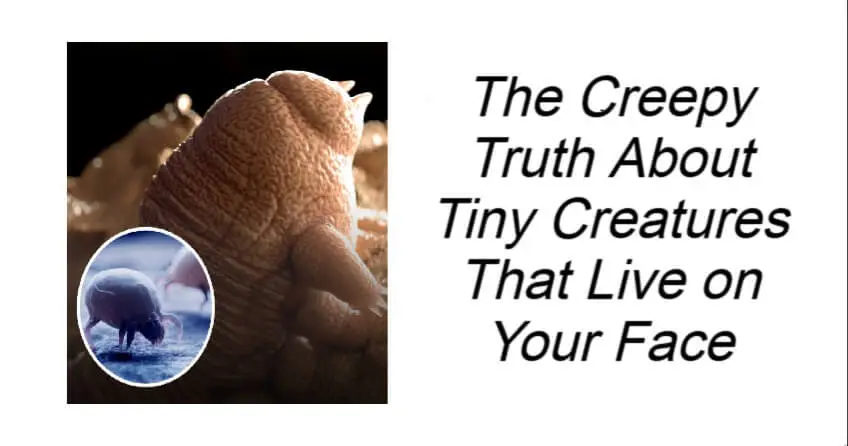
The Creepy Truth About Tiny Creatures That Live on Your Face
When we think about the life forms living on our skin, bacteria usually come to mind — maybe fungi, too. But there’s another resident most people never consider: microscopic mites called Demodex folliculorum. These tiny creatures live deep inside facial pores, where they eat, reproduce, and spend their entire lives — often without us ever knowing they’re there.
Just How Common Are Face Mites?
Surprisingly, these mites are almost universal. Studies estimate that over 90 percent of adults host Demodex mites on their skin. Measuring just 0.3 millimeters long, they’re invisible to the naked eye and typically pass from person to person early in life. Some researchers believe transmission may even occur during close contact in infancy, such as breastfeeding. While their reputation may sound unsettling, humans and Demodex mites have coexisted for centuries.
What Are They Doing in Your Pores?
The idea of mites living in your face can feel unsettling at first — but their role is surprisingly helpful. Demodex mites feed on sebum, the oily substance your skin naturally produces. By consuming excess oil and debris, they help keep pores clearer.
They tend to live in oil-rich areas such as the nose, forehead, and eyelash follicles. At night, when the skin is calm and dark, they emerge from pores to mate on the surface before retreating back inside by morning. It’s a nightly routine that happens entirely beyond our awareness.
An Evolutionary Decline
Recent research suggests that Demodex mites may actually be evolving toward extinction. Their genetic diversity is shrinking, and they’ve lost genes common in other arthropods — including those that protect against ultraviolet radiation. Because they live deep in pores and are active mostly at night, they no longer need those defenses.
Even more fascinating is their loss of independence. Demodex mites no longer rely fully on their own internal clocks. Instead, they respond to human biological signals, such as melatonin released in the skin, to determine when to become active. Their survival has become deeply tied to ours.
From Parasite to Partner
What may have started as a parasitic relationship appears to have evolved into something closer to symbiosis. As the mites became more specialized and genetically reduced, they grew entirely dependent on human skin. In return, humans may benefit from their presence.
By consuming excess oils and clearing debris, Demodex mites may help reduce pore blockages and support overall skin balance. Rather than harming us, they quietly contribute to maintaining a healthy skin ecosystem.
What Would Happen If They Disappeared?
If Demodex mites vanished, the consequences are unclear — but not necessarily positive. Without their oil-clearing role, pores might clog more easily, potentially contributing to skin issues. Their absence would also signal a larger disruption in the delicate microbial ecosystem that supports skin health.
Because these mites are so closely tied to humans, their decline could reflect broader environmental or biological changes affecting countless other species as well.
Can You Get Rid of Them?
In short: no — and there’s no need to try. Demodex mites live deep inside hair follicles, far beyond the reach of ordinary washing or skincare products. Typical cleansers and cosmetics don’t affect them, and medical treatment is rarely necessary unless they overpopulate due to specific skin conditions.
Learning to Live With the Unseen
The thought of microscopic creatures carrying out nightly routines in your pores may sound unsettling, but Demodex folliculorum challenge our ideas about cleanliness and control. Rather than invaders, they’re quiet companions — part of the invisible ecosystem that makes up the human body.
Our skin isn’t just a barrier; it’s a living world of its own. And sometimes, the most fascinating residents are the ones we never see, working silently in the background of our everyday biology.
You’ve just read, Tiny Creatures That Live on Your Face. Why not read Manager Had To Hire A New Employee.