
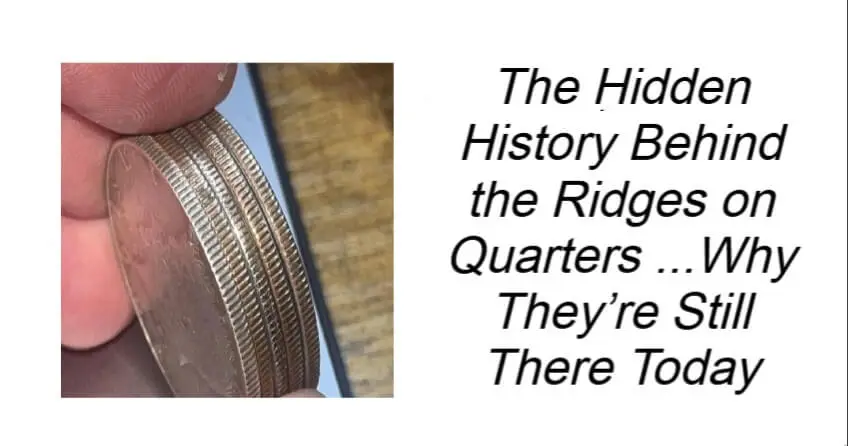
The Hidden History Behind the Ridges on Quarters …Why They’re Still There Today
You’ve held them a thousand times.
Slipped them into parking meters.
Stacked them on countertops.
Flipped them to make life’s big (or small) decisions.
But have you ever really looked at a quarter?
Have you run your thumb along its edge?
Those tiny ridges — sharp, uniform, and oddly satisfying — aren’t just for grip. They’re not decoration. And they’re certainly not an accident.
They’re anti-theft technology dating back over 300 years, to an era of powdered wigs, real silver coins, and a problem that almost toppled an economy.
Let’s dive into the wild, true story of coin ridges — and why they still matter today.
The Crime That Sparked a Revolution: “Coin Clipping”
Back in the 1600s, coins weren’t made from base metals like today. They were minted from precious metals — silver and gold — which gave them their value.
Enter the coin clipper: an opportunistic thief with a steady hand and no conscience.
Their method?
- Shave tiny slivers off the edges of silver or gold coins
- Melt those shavings into new bars of precious metal (bullion)
- Spend the clipped coins as if they were full value
No one noticed if a bit of silver was missing here or there. But multiply that across hundreds — or thousands — of coins?
You’d have a personal treasure chest, and the king would be none the wiser.
But it came at a cost: clipped coins slowly drained the nation’s wealth and trust in its currency. The economy? On the edge of collapse.
The Genius Who Fixed It: Sir Isaac Newton
Yes, that Isaac Newton.
In 1696, the legendary physicist was appointed Warden of the Royal Mint — and one of his first missions?
Stop the coin clippers.
Newton’s solution? Reeded edges.
By adding tiny, machine-pressed ridges around the edge of every silver coin, he made it impossible to shave metal without being noticed.
- A clipped coin would have broken or uneven ridges
- A full coin would have perfect, continuous grooves
- And no counterfeiter could match the Royal Mint’s precision
It was one of the world’s first pieces of anti-counterfeiting technology — and it worked.
✅ Fun fact: Newton personally prosecuted over 100 counterfeiters. Some were even sentenced to hanging.
Why Quarters Still Have Ridges — Even Today
Fast forward to today. Coins are no longer made of silver. So why do quarters, dimes, and half-dollars still have ridges?
Three key reasons:
1. Security Against Counterfeiting
Reeded edges are still part of modern anti-fraud design.
- The exact number and depth of ridges are hard to replicate
- Vending machines and banks use edge sensors to detect counterfeits
- Even with today’s tech, ridges remain a solid line of defense
2. Accessibility for the Visually Impaired
Ridges aren’t just for machines — they’re for people.
For those who are blind or have low vision, texture helps distinguish coins by touch:
- Smooth edge = penny or nickel
- Ridged edge = dime, quarter, or half-dollar
It’s a simple design choice with a massive impact on everyday independence.
✅ While this wasn’t Newton’s intention, it’s one of the most meaningful modern benefits.
3. Tradition & Familiarity
Let’s face it — we expect coins to have ridges. They:
- Feel right
- Sound different when they clink
- Roll a certain way
It’s a small but satisfying part of the tactile experience of money — and in a digital world, those little sensory details still matter.
Why Pennies & Nickels Are Smooth
Have you ever noticed?
- Pennies and nickels → Smooth edges
- Dimes and quarters → Ridged edges
The reason? Value and history.
- Pennies (mostly copper) and nickels (copper-nickel) were never made from precious metals
- With no silver or gold content, they weren’t targets for clipping
- So, no need for reeded edges
Even though modern quarters and dimes are no longer silver, the U.S. Mint kept the ridges for:
- Tradition
- Security
- Tactile distinction
✅ Bonus fact: Half-dollars still have ridges — but most people never notice because they’re rarely used.
The Next Time You Hold a Quarter…
Pause for a second. Run your thumb along the edge.
Those tiny ridges? They carry centuries of history — from Isaac Newton’s genius to clever anti-theft design, to accessibility and tradition.
They’re a reminder that even the smallest things in life often have the biggest stories to tell.
You’ve just read, The Hidden History Behind the Ridges on Quarters. Why not read Manager Had To Hire A New Employee.