
I Fired a Single Mom for Being Late …Then Found Out Why and Begged for Forgiveness
I’ve been a manager for almost six years, and I’ve always believed I was fair. Strict, maybe—but fair. Rules are rules, and if I make an exception for one person, where does it end?
That’s what I told myself last week when I fired Celia.
She was late again—third time this month. Our policy is clear: three strikes, and you’re out. She didn’t argue when I called her in. Just nodded, grabbed her bag, and left. That alone should’ve told me something was wrong.
Later that afternoon, I overheard two coworkers whispering.
“Did you hear about Celia’s son?”
“Yeah,” the other sighed. “Poor kid. They’ve been living in her car.”
My stomach dropped.
I pulled one of them aside. “What do you mean, living in her car?”
Turns out Celia had been evicted a month ago. Her ex had disappeared—no child support, no family around. She was working as much as possible, but with most shelters full, she and her six-year-old had been sleeping in her car. She was late because she had to drive across town to a church that let them shower before she dropped him off at school.
I felt sick.
That night, I couldn’t sleep. I kept thinking about her. She wasn’t late because she didn’t care—she was late because she was surviving. And I’d just made her life even harder.
The next morning, I called her. No answer. I texted. Nothing.
So I drove to the last address we had on file. The apartment manager confirmed what I already knew—she’d been evicted weeks ago.
Now I’m sitting in my car, phone in hand, searching for any way to contact her. I don’t even know if she still has her phone. But I have a job for her if she wants it. More than that—I want to help.
But what if I’m too late?
I don’t know how long I sat there before I finally made a decision: I had to find her. I started calling around—shelters, food banks, churches—anywhere she might have gone. Most couldn’t give me any information, but one woman at a church downtown paused when I mentioned Celia’s name.
“She was here two nights ago,” she said. “Picked up some food and blankets. That’s all I know.”
It wasn’t much, but it was something.
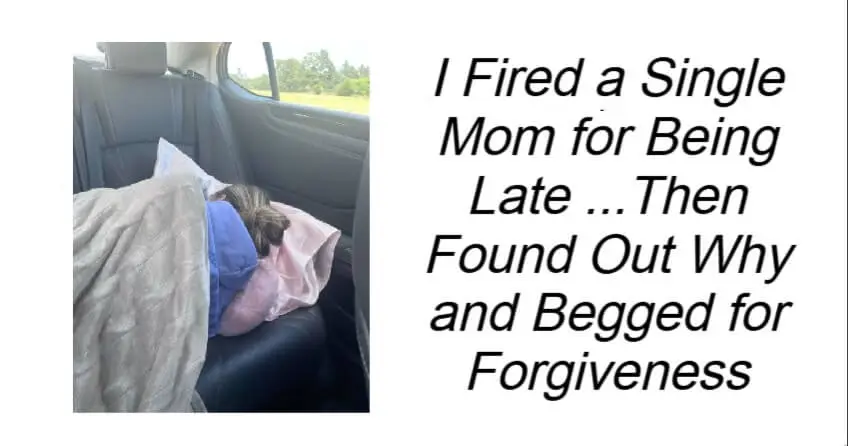
I drove downtown and parked near the church. Maybe she was still nearby. I started walking the streets, checking parking lots, peering into cars—feeling like a creep. I was about to give up when I saw an old sedan in a grocery store lot. The windows were fogged. A small face peeked out from under a blanket in the back seat.
My heart clenched.
I knocked gently on the window. A moment later, Celia sat up in the driver’s seat, eyes cautious. When she saw me, her expression went blank.
“Celia,” I said softly, “I’m so sorry. Please—let me help.”
She hesitated, then rolled the window down just a crack. “Help?” Her voice was flat. “Like you helped last week?”
I deserved that.
“I didn’t know,” I said. “I should have asked. I should have seen it. But I just followed the rules instead of seeing the person right in front of me.”
She didn’t respond. Her son stirred in the back, still curled under the blanket.
“Come back to work,” I said. “Your job’s still here if you want it. And more than that—I want to help you get back on your feet.”
She gave a hollow laugh. “Help how? With a paycheck that barely covers rent?”
She was right. A job alone wasn’t enough.
“I can do more,” I said. “My cousin manages an apartment complex—they have a unit open, no deposit needed. I’ll help you get in. I’ll call around—there are programs that can help with food, childcare… we’ll figure it out.”
She stared at me. “Why?”
“Because I failed you,” I said. “Because I was so focused on the rules, I forgot to be human. You don’t deserve this. Neither does your son.”
She looked back at him, then at me. Her shoulders trembled.
“Okay,” she whispered.
The next few weeks were a blur. My cousin got her into the apartment. My company agreed to bump up her pay slightly, and I used every contact I had to connect her with assistance programs. It wasn’t a perfect fix, but it was a beginning.
One afternoon, Celia stopped by my office.
“I just wanted to say thank you,” she said. “Not just for the job. For seeing me.”
“I should’ve seen you from the start,” I admitted.
She smiled—and this time, it reached her eyes.
That night, I sat in my car, thinking about how close I came to making an unforgivable mistake. We get so caught up in rules and policies that we forget people aren’t just names on a timesheet. Everyone has a story, and sometimes, all it takes is someone willing to listen.
If I’ve learned anything from all of this, it’s this: Kindness shouldn’t come with conditions. And sometimes, the right thing to do is to break the rules.
You’ve just read, I Fired a Single Mom for Being Late. Why not read Manager Had To Hire A New Employee.